The call came in at 6:40 on a Tuesday morning in late April. A woman driving to work on Route 9 outside of Chattanooga, Tennessee, had pulled over to check on what she thought was a dead dog lying on the gravel shoulder near a shuttered gas station. The dog was not dead. She was breathing. But she was so thin and so still that the difference was hard to see from a moving car.
The Dog on Route 9
The woman's name was Angela Briggs. She was a dental hygienist. She had never rescued an animal before. She told me she almost kept driving — she was already running late, and the shape on the shoulder of the road didn't register as alive until she was almost past it. But something made her look in the rearview mirror. She saw the ribcage move. One slow, shallow rise. That was enough.
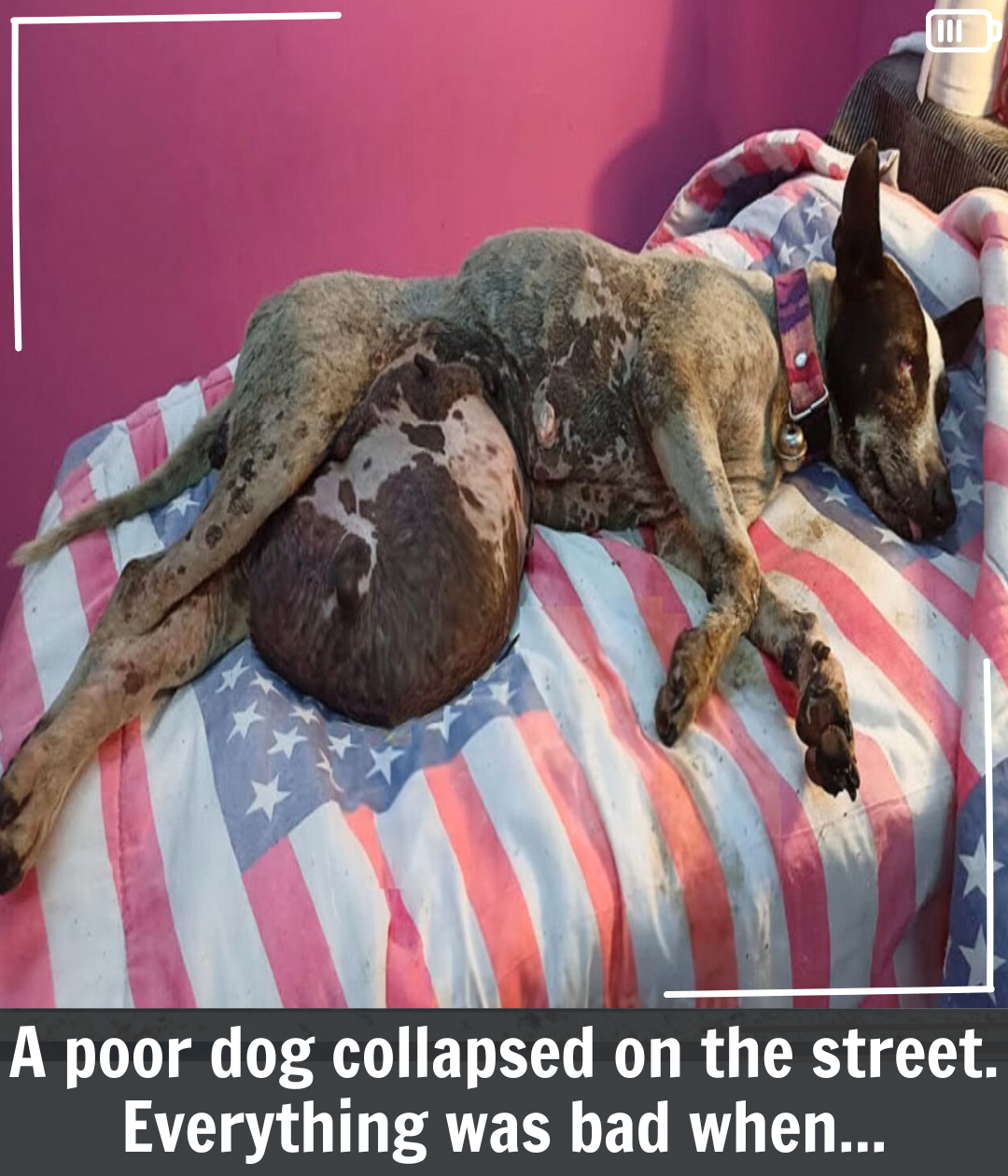
She pulled over and walked back along the shoulder. The dog was lying on her side in the gravel, about four feet from the road. She was a medium-sized mixed breed — maybe forty pounds, though it was hard to tell because there was almost nothing left of her. Her coat was patchy and dull, brown and white with dark spots, streaked with mud. Her ribs weren't just visible — they were the most prominent thing about her. Each one stood out like a finger pressing through fabric. Her hip bones jutted upward. Her legs were thin and trembling slightly, even though she wasn't trying to move.
And her belly was swollen. Not in the way a fed dog's belly looks after a meal. Swollen in a way that looked wrong — tight and round and heavy, as if something inside her was growing while the rest of her was disappearing.
Angela knelt beside her. The dog's eyes were open. They were brown and glassy and they tracked Angela's face without any fear or hope. Just awareness. She did not try to get up. She did not wag her tail. She did not flinch when Angela's hand touched the top of her head. She was past all of that. She was in the place that animals go when they have been alone long enough that they stop expecting anything from people.
Angela called the number on the side of the nearest animal rescue van she could find on Google. The phone was answered by a man named Curtis Webb, who ran a small rescue operation out of a converted warehouse on the south side of Chattanooga. He told Angela to stay with the dog. He was on his way.
What the Ultrasound Showed
Curtis arrived in fourteen minutes with a crate, a blanket, and a bowl of water. The dog drank the water in long, desperate pulls. He lifted her into the crate. She weighed thirty-one pounds. A dog her size should have weighed fifty.
He drove her directly to Dr. Lena Marchetti's veterinary clinic on Brainerd Road. Dr. Marchetti had been working with Curtis's rescue for six years. She had seen starving dogs before. She had seen dogs that had been on their own for weeks, months. But she told me that when she saw this dog on the exam table, she had to take a breath before she started the examination.
The dog's body condition score was a 1 out of 9 — the lowest possible rating. Her gums were pale. Her coat was falling out in patches. She had sores on her elbows and hips from lying on hard ground. Her muscles had atrophied to the point where her skeleton was doing most of the structural work of holding her body together.
And then there was the belly.
Dr. Marchetti told me she initially suspected a tumor. A large abdominal mass in a dog this emaciated was the most likely explanation. She turned on the ultrasound machine, applied the gel to the dog's distended abdomen, and placed the probe against her skin.
She went quiet for about fifteen seconds. Curtis, who was standing on the other side of the table holding the dog's head, said the silence felt much longer than that.
Then Dr. Marchetti said: "There are two heartbeats."
Not a tumor. Puppies. Two of them. Alive, moving, their tiny hearts flickering on the screen inside a mother who was starving to death.
Curtis told me he put both hands on the table and stared at the ultrasound monitor and did not say anything for a while. He said: "I have been doing rescue work for eleven years. I thought I had seen everything that could break your heart in this job. I had not seen this. I had not seen a dog who was dying of starvation carrying living puppies inside her. She was giving them everything she had left. Every calorie, every bit of strength — it was all going to them. She was keeping them alive by letting herself disappear."
The Surgery
Dr. Marchetti told Curtis that the puppies could not survive a natural birth. The mother was too weak. Her body did not have the reserves to sustain labor. An emergency cesarean section was the only option, and even that carried enormous risk. A dog this malnourished might not survive anesthesia. Her heart might stop on the table.
Curtis authorized the surgery. He did not hesitate. He told me: "There was no decision to make. There were three lives on that table. We were going to fight for all three."
The surgery took forty-seven minutes. Dr. Marchetti worked with two veterinary technicians, monitoring the mother's vitals continuously. Her heart rate was unstable. Her blood pressure dropped twice during the procedure. Both times, Dr. Marchetti stabilized her and continued.
The first puppy came out moving. She was small — impossibly small, barely the size of a woman's fist — but she was breathing and squirming and her mouth opened in a silent cry. The technician cleared her airway and wrapped her in a warm towel.
The second puppy was still.
They tried for four minutes. Gentle chest compressions. Stimulation. Warmth. The puppy did not respond. Dr. Marchetti called it at 9:23 AM. She told me she stood at the table for a moment with the still puppy in her hands and then set it down carefully on a clean towel and turned back to the mother, who was still under anesthesia and whose heart was still beating and whose surviving puppy was crying in a towel on the warming table six feet away.
"You don't get to stop," she said. "Not in this work. You grieve and you keep going because the ones who are still alive need you to keep going."
The First Week
The mother could not nurse. Her body had nothing left to give. The surviving puppy was fed by hand every two hours — a tiny syringe of puppy formula, held to her mouth by whichever technician was on shift. The feeding schedule ran around the clock. Curtis took the overnight shifts himself, sitting in a chair next to the incubator with an alarm set on his phone for every two hours.
The mother was placed on IV fluids, high-calorie recovery food, and a regimen of supplements. She ate slowly at first. Small amounts, every few hours. Her body had been in starvation mode for so long that refeeding had to be carefully managed — too much food too fast could kill her.
On the second day, the mother lifted her head when the puppy cried. On the third day, she turned her body toward the sound. On the fourth day, Curtis placed the puppy next to her on the blanket in her recovery kennel, and the mother lowered her nose to the puppy's head and breathed in slowly, and something in her eyes changed. Not brightness exactly. Recognition. The understanding that the thing she had been carrying and protecting and starving for was here, outside of her now, alive and warm and close enough to touch.
By day six, she was producing a small amount of milk. Not enough to sustain the puppy alone, but enough that the puppy could nurse for a few minutes at a time between bottle feedings. Dr. Marchetti said this was medically remarkable. A dog in her condition should not have been able to lactate at all. Her body was rebuilding itself and feeding another life at the same time.
What They Named Them
Curtis named the mother Ruth. He said it was his grandmother's name, and his grandmother had been a woman who held her family together through things that should have broken her and never once complained about it. He said the name felt right.
The puppy was named Ada. One of the veterinary technicians chose it. She said it meant "noble" in German, and that any creature who had survived what Ada survived — carried inside a starving body, born on an emergency table, orphaned of a sibling in her first minute of life — had earned a noble name.
Eight Weeks Later
Ruth gained nineteen pounds in the first eight weeks. Her coat grew back. The sores on her elbows healed. Her eyes, which had been glassy and distant on the morning Angela found her, became clear and warm and watchful. She watched everyone who came into the room, but she watched Ada most of all.
Ada grew from the size of a fist to a fat, clumsy, four-pound puppy who tripped over her own ears and fell asleep in the middle of eating. She nursed from Ruth and also took a bottle, and she had the specific, unshakable confidence of a creature who had never once, from the moment of her birth, been left alone.
A family in Nashville adopted them together. Curtis told me this was non-negotiable — Ruth and Ada would not be separated. The family had two children, a fenced yard, and a golden retriever named Biscuit who, according to the adoption coordinator, seemed genuinely delighted to have company.
I asked Curtis what he thinks about when he looks at the photo of Ruth from that first morning — the one Angela took on her phone before the rescue van arrived, showing a skeleton with a swollen belly lying in gravel on the side of a highway.
He was quiet for a moment. Then he said: "I think about the fact that she was dying. She was actually dying. And the whole time she was dying, she was keeping those puppies alive. Every single thing her body had left — every calorie, every nutrient, every bit of energy — she sent it to them. She was not eating for herself. She was eating to keep them going. And when she stopped being able to eat, she started using her own body. Her muscles. Her fat. Everything. She gave them everything until there was almost nothing left of her."
He paused.
"People talk about love like it is a feeling," he said. "It is not a feeling. It is what Ruth did. It is starving to death on the side of a road and using the last thing you have to keep someone else alive. That is what love looks like when everything else is gone."