The river had been rising for two days. Not fast enough to make the news. Not slow enough to ignore. It was the kind of rise that happens quietly — the water creeping a few inches higher each morning, swallowing the rocks that were dry yesterday, pulling the current faster than it was the day before. The kind of rise that changes things before anyone notices they have changed.
On Tuesday afternoon, a twelve-foot section of the eastern riverbank outside of Carver, Tennessee gave way. Not with a crash. Not with a sound anyone would remember. Just a slow, heavy lean — the grass tilting forward, the roots pulling loose from the clay underneath, and then the whole shelf of earth sliding into the water and disappearing beneath the brown current like it had never been there at all.
Where there had been solid ground, there was now a raw, jagged cliff of red dirt and exposed roots hanging over fast-moving water four feet below.
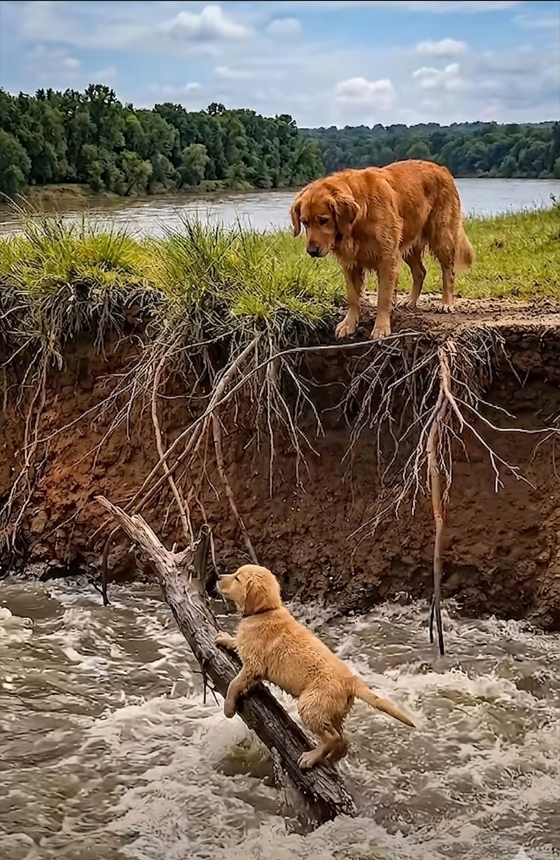
And at the bottom of that cliff, halfway submerged in the current, a golden retriever puppy was holding on to a dead branch with everything he had.
He Was Not Supposed To Be There
The Webber family had owned the property along the river for eleven years. Their golden retriever, Sadie, had given birth to a litter of five puppies eight weeks earlier in a whelping box in the laundry room. By week six, the puppies were everywhere — the porch, the yard, the garden, the driveway. Anywhere Sadie went, five golden blurs followed.
The river was off limits. There was no fence between the yard and the bank — there had never needed to be one. The bank had always been solid. Wide. Covered in thick grass that held the soil in place. The dogs would wander to the edge sometimes, sniff the air, and come back. It was not a danger. It was just the end of the yard.
Until the rain changed that.
Until the ground that had been solid for a decade decided, on a Tuesday afternoon with no warning, to stop being solid.
Karen Webber was inside when it happened. She heard Sadie bark — not the bark she used for squirrels or the mailman or the neighbor's cat. A different bark. A sound Karen had never heard from her before. Deep. Rapid. Desperate. The kind of bark that comes from a place below training and habit and personality — from somewhere ancient and hardwired and impossible to ignore.
Karen ran to the back door. She could see Sadie at the edge of the yard, at the spot where the riverbank used to be. She was standing on the broken lip of earth — right at the edge, right where the ground had sheared away — looking straight down.
Four puppies were behind her in the grass, confused, tumbling over each other the way puppies do when the world changes too fast for them to understand.
The fifth puppy was not there.
She Could See Him But She Could Not Reach Him
His name was Biscuit. He was the smallest of the litter. The one who always wandered farthest. The one who always found the one gap in whatever barrier you put up and squeezed through it before you realized he was gone. The curious one. The brave one. The one who did not know enough about the world yet to be afraid of it.
He had been at the edge of the bank when it collapsed. The ground had fallen out from under him — literally — and he had tumbled four feet down the raw dirt face and into the rushing water below.
He should have been swept away. The current was strong enough to move logs. Strong enough to pull a grown man off his feet. A seven-pound puppy had no chance against it.
But there was a branch. A dead tree limb, thick and gnarled, jutting out from the collapsed bank about two feet above the waterline. It had been buried in the soil and exposed when the earth gave way. And Biscuit — by luck or instinct or something nobody would ever be able to explain — had caught it.
His front paws were wrapped around the branch. His back legs dangled in the current, the water pulling at him, tugging his small body downstream. His claws dug into the bark. His head was just above the surface. His eyes were wide and locked upward — on the edge of the cliff, on the shape standing above him.
On his mother.
Sadie was four feet above him. Standing on dirt that was still crumbling. Chunks of clay broke loose under her paws and tumbled down the face into the water every few seconds. The edge she was standing on was not stable. It could go at any moment. And she knew it — you could see it in the way her legs trembled, in the way her weight shifted backward even as her head pushed forward over the edge.
She was looking directly down at her puppy. Her body was rigid. Every muscle locked. Her ears were pressed flat against her skull. Her mouth was open but no sound was coming out anymore — just fast, shallow panting, her breath visible in the cool air.
She wanted to go down. Everything in her body was telling her to jump, to slide, to get to her puppy by any means necessary. But something — some calculation that dogs make without knowing they are making it — told her that if she went down, she would not come back up. And neither would he.
So she stood there. On the breaking edge. Shaking. Watching. Refusing to leave.
His Paws Were Slipping
Karen saw it all in the three seconds it took her to process what was happening. The collapsed bank. The water. The branch. The puppy. The mother.
She ran.
Not to the edge — she could see that the ground near Sadie was unstable. She ran to the garage. Grabbed a rope. Grabbed a plastic storage bin. Grabbed a towel. She did not have a plan. She had materials and adrenaline and a puppy in the water whose grip was failing.
By the time she got back, Biscuit's right paw had slipped off the branch. He was holding on with one paw now — his left front — his small claws hooked into a crack in the bark. His body swung sideways in the current. His back end was completely underwater. His head tilted up, mouth open, gasping.
Sadie let out a sound that Karen would never forget. Not a bark. Not a whine. Something between the two — a broken, guttural cry that came from deep in her chest. The sound a mother makes when she is watching her child in danger and cannot do anything to stop it.
Karen tied the rope to a tree trunk ten feet back from the edge — the only anchor point she trusted. She looped the other end around her waist. Then she got on her stomach and crawled to the edge, distributing her weight across the soft ground, inches at a time.
Sadie did not move. She stayed exactly where she was — at the very lip of the drop — as if leaving that spot would mean giving up. As if her presence alone was holding her puppy in place.
Karen reached the edge. She looked down. Biscuit was three feet below her. Close enough to see the whites of his eyes. Close enough to see his claws bending against the bark. Close enough to hear the small, choked sounds he was making every time the water surged and pulled at his body.
She reached down with both hands.
She could not reach him.
Six inches short. Maybe eight. The branch was too far out from the bank face, angled away from the cliff by the way the tree had grown. Her fingers stretched into the air above his head. So close. Not close enough.
What Sadie Did Next
Karen was about to pull back and find something longer — a stick, a pole, anything — when Sadie moved.
The dog stepped forward. Past Karen. Past the edge of stable ground. Onto the exposed root system that hung over the drop like a tangled net of wood and dirt. The roots bent under her weight. Soil crumbled and fell. The whole section shifted — a sickening lurch that made Karen's stomach drop.
But Sadie kept going. She lowered her front half down the root system, her back paws digging into the dirt above, her front paws bracing against a thick root that curved out over the water. Her body was almost vertical — stretched down the face of the collapsed bank at an angle that should have been impossible for a dog her size.
She extended her neck. Stretched her head as far as it would go. And she clamped her teeth — gently, firmly, precisely — around the scruff of Biscuit's neck.
The puppy's paw slipped off the branch at almost the same moment. His body dropped. The current grabbed him. His full weight — seven pounds of wet, exhausted, terrified puppy — hung from his mother's mouth.
Sadie's body shuddered. Her front legs trembled against the root. Her back claws tore into the dirt. A sound came from her throat — muffled by the fur in her mouth — a deep, grinding effort sound that was not a bark or a growl but something more fundamental. The sound of a body refusing to let go.
Karen grabbed Sadie's collar with one hand and the root system with the other. She pulled. Sadie pushed. The dirt shifted and crumbled and the roots groaned under the weight of all three of them.
It took eleven seconds. Eleven seconds of pulling and sliding and dirt falling and water rushing and Sadie's jaws locked so tight around her puppy's scruff that the muscles in her neck stood out like cables.
Then Biscuit was on the grass.
Then Sadie was on the grass.
Then Karen was on her back in the yard, rope still around her waist, staring at the sky, breathing like she had just run a mile.
She Did Not Let Go
Biscuit lay on the grass, coughing, shaking, his small body soaked and streaked with red clay. He was alive. Breathing. Conscious. His legs moved weakly — paddling motions, as if his body had not yet realized it was no longer in the water.
Sadie stood over him. She did not sit down. She did not rest. She stood with all four legs planted around his body like a cage made of muscle and fur and maternal refusal. Her head was low. Her nose pressed against his side. She licked him — his face, his ears, his belly, his paws — long, firm, deliberate strokes that cleaned the mud and checked for injury and said I am here, I am here, I have you, you are safe in the only language she had.
The other four puppies came tumbling over. They piled around their brother, sniffing and nipping and climbing on top of him in the clumsy, joyful way that puppies greet anything that returns from somewhere they could not follow.
Sadie let them come. But she did not move. She stayed standing over Biscuit for a long time after that. Even after he stopped shaking. Even after his breathing returned to normal. Even after he rolled onto his belly and tried to stand on wobbly legs.
She was not going to lose sight of him again. Not today.
What Karen Cannot Forget
Karen sat on the porch that evening after the vet had checked Biscuit and confirmed he was fine — cold, tired, a small scratch on his belly pad, but otherwise unharmed. Sadie was inside, lying on the laundry room floor with all five puppies pressed against her.
Karen's husband had already driven stakes and temporary fencing along the new edge of the riverbank. The branch Biscuit had clung to was gone — snapped off and carried downstream sometime that afternoon.
She thought about that. About how a branch that had been buried in dirt for years — invisible, useless, forgotten — had been exposed at the exact moment a puppy needed something to hold on to. About how it had lasted just long enough. About how it was gone now, as if it had served its only purpose and the river had taken it back.
But mostly she thought about Sadie.
About a dog who had stood on ground that was falling apart beneath her and refused to move. Who had climbed down a collapsing wall of dirt and roots to reach something she loved. Who had held seven pounds in her mouth while her own body was sliding toward the water and did not open her jaw. Not for one second. Not for one inch.
She thought about the sound Sadie had made — that muffled, grinding, impossible sound — and she understood that it was not strength. It was not training. It was not instinct in the way people usually mean when they use that word to explain away something an animal does that seems too big for an animal to do.
It was a choice.
A mother, on a collapsing cliff, choosing to hold on.
That is what love sounds like when it has no words. It sounds like teeth on fur and claws on dirt and a body that will break before it lets go.