It was past midnight and the rain had been falling for six hours straight. The kind of rain that doesn't just fall — it punishes. It hits the ground so hard it bounces back up. It fills every crack, every gutter, every low spot in the pavement until the world is nothing but noise and water and cold. In a narrow alley behind a row of closed shops on Dayton Street, a mother cat lay on her side in a puddle she no longer had the strength to crawl out of.
She Couldn't Stand Up
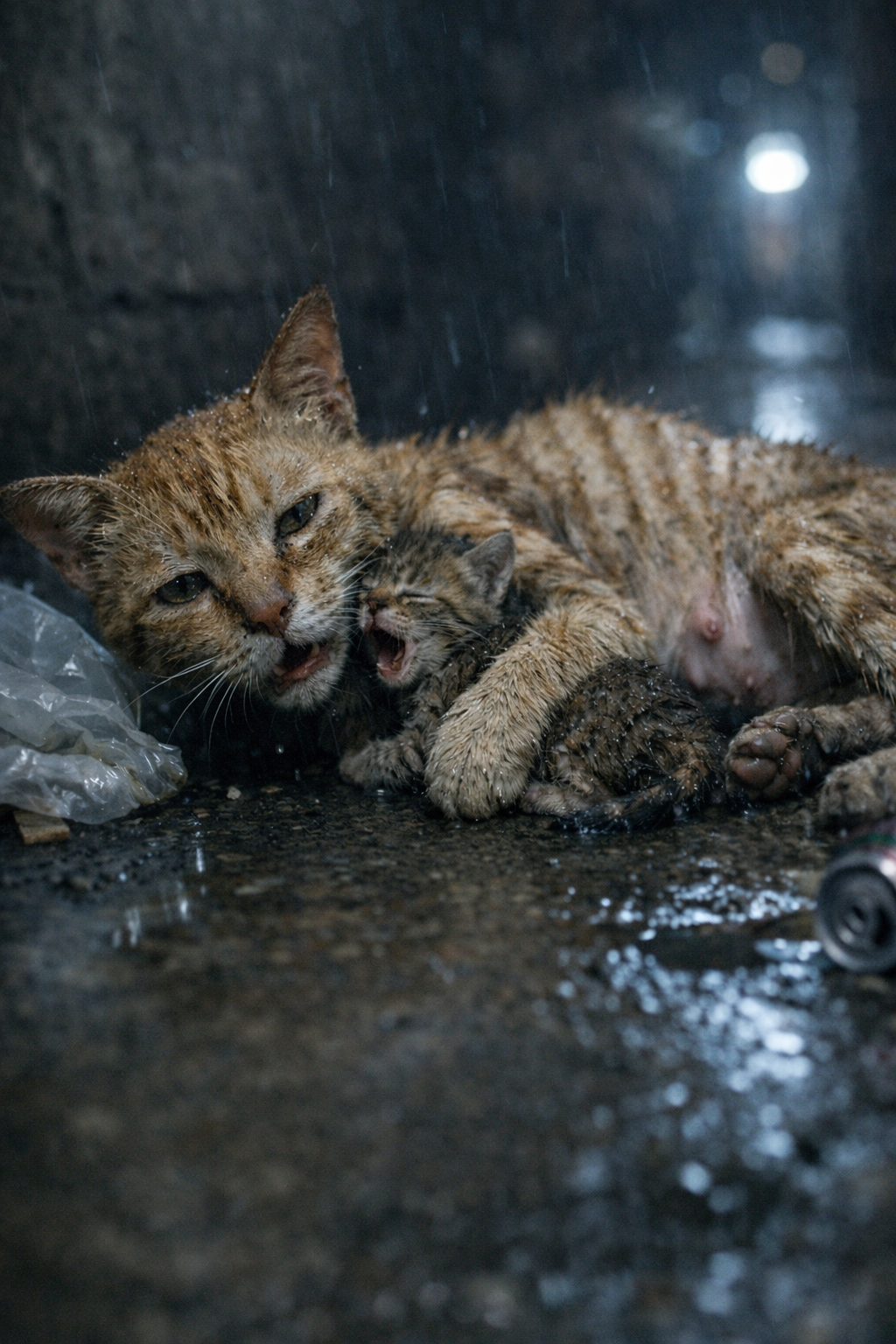
Her legs had stopped working sometime around sundown. Not all at once. First the back left one gave out — a slow buckle, like a table losing a leg. Then the right one followed. She had managed to drag herself a few feet closer to the wall, where the overhang of a fire escape kept the worst of the rain off. But the water still reached her. It crept across the concrete in thin, cold streams and pooled around her belly and her paws and the small body pressed against her chest.
She was orange tabby. At least she had been. Now she was the color of wet dirt — her fur soaked flat against her skeleton, every rib visible, every vertebra a small mountain ridge running down her back. Her face was narrow and sharp, the kind of thin that happens when a body has been eating itself for weeks. Her eyes were half-open, dull, unfocused — looking at nothing and everything at the same time.
She weighed maybe four pounds. A healthy cat her size should have been nine.
The Kitten
He was tucked against her chest, between her front paws, pressed into the hollow space where her ribs met her belly. He was tiny — maybe three weeks old, maybe less. Hard to tell when they're this small and this hungry. His fur was the same orange tabby as hers, but darker from the rain and the grime of the alley floor.
His mouth was open. Wide open. He was crying — or trying to. The sound that came out was thin and broken, more air than voice, the kind of cry that happens when a kitten has been screaming for so long that its throat has given up but its body hasn't gotten the message yet.
He was rooting against her belly. Pushing his face into her fur, searching for a nipple, searching for milk, searching for the thing that was supposed to be there — the thing that had always been there — the thing that meant survival and warmth and the world is okay and mama is here.
There was nothing.
Her milk had dried up two days ago. Her body had nothing left to convert. No fat. No protein. No reserves of any kind. The biological machinery that turns a mother's body into food for her young had run out of raw material and shut down. Her nipples were cracked and dry. When the kitten latched on and pulled, nothing came. He would try, fail, unlatch, cry, and try again. Over and over. Every few minutes. All night.
She felt every attempt. She felt his tiny mouth pulling at her. She felt the nothing that came out. And each time, she would lower her head and lick his face — slow, rough, deliberate strokes of her tongue across his eyes and his ears and his nose — because it was the only thing she had left to give him.
She couldn't feed him. So she cleaned him. She couldn't save him. So she held him. She couldn't make the rain stop. So she curled tighter around his body and let the water hit her back instead of his face.
How They Got Here
She had been someone's cat once. Not a loved one — not the kind that sleeps on the bed and gets brushed and has a name that people say with affection. The kind that exists in the background. The kind that lives in a garage or under a porch and gets fed sometimes and ignored the rest of the time.
When she got pregnant, the feeding stopped. The door that used to open didn't open anymore. The bowl that used to appear didn't appear. She waited for two days, then three, then a week. Then she understood.
She left. Not because she wanted to. Because she had to. Because the kittens inside her were going to come whether there was a bowl by the door or not, and she needed to find a place where they had a chance.
She found the alley. It wasn't much — a narrow gap between a dry cleaner and a nail salon, with dumpsters on one end and a chain-link fence on the other. But it was sheltered. It was hidden. It was the best she could do.
She gave birth to three kittens on a Tuesday night in April. Alone. No help. No warmth except her own body. No light except a streetlamp on the corner that buzzed and flickered and cast long shadows down the alley walls.
Three kittens. All alive. All breathing. All finding her in the dark by smell and instinct, latching on, drinking, surviving.
The first one died on day four. It was the smallest — a gray and white female who never quite figured out how to latch properly. She faded slowly, like a candle running out of wax, until she was still and the mother carried her to the far end of the alley and came back and fed the remaining two.
The second died on day nine. An infection. His eyes swelled shut and a yellow discharge matted the fur on his face and he cried in a way that was different from hunger — a high, sharp sound that meant pain. She cleaned his eyes constantly, licking away the discharge, trying to fix what her tongue couldn't fix. He died in the night. She carried him to the same spot as his sister.
Now there was one. One kitten. The last one. The only heartbeat left besides her own.
What It Costs to Keep One Alive
She hunted every day. Hunted is a generous word for what she did. She scavenged. She searched. She walked the alley at dawn and dusk, checking the dumpsters, nosing through garbage bags, licking grease off discarded food wrappers. She found things that weren't food and ate them anyway because her body was so desperate for calories that it would try to extract nutrition from cardboard and plastic wrap.
She ate so her body could make milk. That was the equation. That was the math. Everything she found, everything she forced down, was converted into the white liquid that kept the last kitten alive. She was a machine. A factory. A system with one input and one output, and the input was running dangerously low.
She lost weight she didn't have to lose. Her hip bones jutted out like doorknobs. Her tail was a rope. Her face narrowed until her eyes looked too big for her skull, giving her the expression of permanent shock — which wasn't far from the truth.
But the kitten grew. Slowly. Not as fast as he should have. But he grew. His eyes opened. He started crawling. He started making sounds that weren't just cries but something closer to communication — small chirps when he was content, loud wails when he was hungry, a deep rumbling purr when he was pressed against her and the world was quiet and warm.
She was dying so he could live. She knew this the way animals know things — not with words, not with logic, but with a certainty that lives in the blood and the bone. Her body was shutting down. Her organs were under stress. Her heart was working harder than it should to pump blood that was thin and weak through veins that were collapsing.
She didn't care. She had one job. One purpose. One reason to keep breathing.
He was lying against her chest with his mouth open, screaming for milk that wasn't coming.
The Rain
The storm started at 6 PM and it didn't stop. The alley flooded fast — water pouring off the rooftops, pooling between the dumpsters, rising inch by inch until the ground she was lying on became a shallow river.
She tried to move. She pushed herself up on her front legs, gathered the kitten in her mouth by the scruff, and tried to stand. Her back legs shook. They folded. She collapsed. The kitten swung from her mouth and cried.
She tried again. Same result. Her muscles had consumed themselves weeks ago. There was nothing left to power her legs.
So she did the only thing she could. She rolled onto her side, pulled the kitten against her chest with her front paws, and positioned her body between him and the water. The rain hit her back, ran down her sides, pooled around her belly. But the kitten was dry. Or drier. Or at least not drowning.
She lay there all night. In the rain. In the cold. In a puddle that smelled like garbage and motor oil. She lay there shaking — not from cold, though she was cold. From the effort of staying alive. From the work of keeping her heart beating, her lungs filling, her body functioning at the absolute minimum level required to be a wall between her kitten and the world.
The kitten cried. He cried and cried and cried. His mouth opened and closed against her chest. He was hungry. He was scared. He was three weeks old and he didn't understand why the rain was so loud or why the ground was so wet or why the milk wouldn't come no matter how hard he tried.
She licked his face. Again. And again. And again. Because that was all she had.
Morning
The rain slowed around 5 AM. It didn't stop, but it softened — from a downpour to a drizzle, from violence to something almost gentle. The sky went from black to dark gray. The streetlamp on the corner flickered off.
She was still alive. Barely. Her breathing was shallow and fast — too fast. Her body was hypothermic. Her eyes were open but she wasn't really seeing anymore. The world had become a blur of shapes and light and the feeling of a small warm body against her chest that she needed to protect.
The kitten had stopped crying. He was pressed against her, eyes closed, body still. For a terrible moment, she thought — but no. She felt his breathing. Small. Fast. Still there. He had just exhausted himself. He had cried all night until his body decided that silence was better than screaming into nothing.
A garbage truck rumbled down the street at the end of the alley. A man walked past with an umbrella, his shoes clicking on the wet sidewalk. A car started somewhere nearby, engine turning over twice before catching.
The world was waking up. The world was moving. The world was doing all the things it does every morning without knowing or caring that in a puddle in an alley, a mother who weighed four pounds was using the last of her life to keep a three-week-old kitten warm.
Amy
Her name was Amy Nguyen and she worked the opening shift at the dry cleaner that shared a wall with the alley. She parked in the back lot and walked through the alley to the side door every morning at 6:15 AM. She had done this for three years. She knew every crack in the pavement, every stain on the walls, every dumpster and its smell.
She had seen strays before. The alley had them sometimes — cats mostly, sometimes raccoons, once a possum that scared her so badly she dropped her coffee. She usually kept walking. Not because she didn't care, but because the world is full of stray things and you can't stop for all of them.
But this morning she stopped.
She stopped because she heard the sound before she saw them. A tiny, broken cry coming from somewhere near the ground. Not a bird. Not a rat. Something smaller. Something desperate.
She looked down and saw the mother cat lying in a puddle by the wall. Soaked. Skeletal. Not moving except for the rise and fall of her ribs. And pressed against her chest, a kitten. Mouth open. Eyes closed. Making a sound that was barely a sound — more like a vibration, a frequency of need that bypassed the ears and went straight to the chest.
Amy crouched down. The mother cat's eyes moved toward her. Not her head — she didn't have the strength to turn her head. Just her eyes. Slow. Heavy. Looking at Amy with an expression that had no pride, no fear, no fight left in it.
Just one thing. One single thing in those eyes.
Please.
Amy had seen a lot of sad things in her life. She had buried her father at nineteen. She had lost a pregnancy at twenty-six. She had held her best friend's hand in a hospital room while machines beeped and hope left the building one number at a time.
But this — a cat too weak to lift her head, lying in a puddle in the rain, holding a screaming kitten against a body that had nothing left — this was the thing that broke her.
She didn't call anyone. She didn't go inside first. She took off her jacket, crouched down in the puddle in her work clothes, and scooped them up. Both of them. Together. The mother didn't resist. She didn't hiss. She didn't even tense. She just let it happen, the way you let things happen when you've been fighting alone for so long that the arrival of help feels less like rescue and more like permission to finally stop.
Amy held them against her chest. The mother was so light it was horrifying — like holding a paper bag filled with sticks. The kitten was a warm lump between them, still making that broken sound, still searching for milk, still alive in spite of everything that had tried to kill him.
Amy's shirt was soaked. Her pants were soaked. She was kneeling in a filthy puddle in an alley behind her job at 6:15 in the morning holding two animals she had never seen before.
And she was crying harder than she had cried in years.
The Clinic
The emergency vet was twelve minutes away. Amy drove with the mother and kitten wrapped in her jacket on the passenger seat. She kept one hand on them the entire time. She could feel the mother's heartbeat through the fabric — fast, irregular, weak. Like a clock running out of batteries.
The vet — Dr. Sarah Okafor — took one look and started moving. No pleasantries. No paperwork first. Just gloves on, stethoscope out, and a look on her face that said this is bad but I've seen bad before and I didn't become a vet to give up.
The mother was in critical condition. Core temperature 94 degrees — dangerously low. Heart rate elevated. Severe dehydration. Severe malnutrition. Her organs were beginning to fail. Her kidneys were barely functioning. Her body had been cannibalizing its own muscle tissue for weeks to produce milk that had finally run out.
The kitten was dehydrated and underweight but stable. His lungs were clear. His heartbeat was strong. He was hungry — ravenously, desperately hungry — but he was alive. He was alive because a four-pound cat had spent three weeks converting her own body into food for him.
Dr. Okafor started IV fluids on the mother. Warmed her with heating pads and thermal blankets. Gave her glucose and electrolytes and antibiotics and the medical equivalent of begging a body not to quit.
The kitten was given formula from a syringe. He latched onto it so hard the vet tech had to hold the syringe with both hands. He drank until his tiny belly was round and tight, and then he curled up against his mother's side and slept — a real sleep, deep and still, the sleep of someone who had finally gotten the thing they'd been screaming for.
The mother didn't sleep. Even with fluids running into her veins and warmth returning to her body, she didn't close her eyes. She lay there, head on the towel, and watched the kitten breathe. In. Out. In. Out. Counting each breath the way she had been counting them for three weeks. Making sure. Always making sure.
Seventy-Two Hours
The vet said the first seventy-two hours would decide everything. Either the mother's organs would recover, or they wouldn't. Either her body would accept the help, or it would shut down the way bodies do when they've been pushed past what they were built to endure.
Amy came back every day. Before her shift. After her shift. On her lunch break. She sat on the floor of the recovery room and talked to the mother cat in a low, steady voice — not saying anything in particular, just making sound. Human sound. The sound of someone being present.
On the first night, the mother's kidneys showed improvement. Small, but measurable. Her temperature stabilized. Her heart rate came down from frantic to merely fast.
On the second day, she ate. Not much. A few licks of wet food from a spoon that the vet tech held to her mouth. But she ate. Her body remembered how to do something besides produce milk and suffer.
On the third morning, she lifted her head.
She lifted her head and looked at the kitten sleeping beside her and then she looked at Amy, who was sitting cross-legged on the floor with coffee she hadn't touched going cold in her hand. The mother looked at her. Really looked at her. And then she did something that made Amy set down her coffee and cover her mouth with her hand.
She purred.
A rough, raspy, broken purr that sounded like an engine trying to start after years of sitting unused. But it was a purr. The first sound she had made in three days that wasn't a breath or a whimper.
She was going to make it.
Home
Amy adopted them both. She didn't hesitate. She didn't think about it. She didn't weigh the pros and cons or check her budget or consider the timing. She just said yes. The way you say yes to things that aren't really questions — things that have already been decided by something deeper than logic.
She named the mother Rain. Because that's where she found her. In the rain. In a puddle. Holding on.
She named the kitten Lucky. Not because luck had anything to do with it. But because against every odd, against every night, against every empty belly and dry nipple and cold puddle and unanswered cry — he was here. He was alive. He was purring in a warm house on a soft bed next to a mother who had burned herself down to ash to keep him breathing.
Rain gained weight slowly. Her fur came back — orange and gold and striped, the way it was supposed to be before the world took everything from her. Her legs got strong again. She could walk, then jump, then run. She discovered windows and sunlight and the sound of a can opener, which made her ears rotate forward and her eyes go wide every single time.
But the thing she did most was sleep. Deep, heavy, motionless sleep. The kind of sleep that comes after you've been awake for a lifetime. She slept on the couch. She slept on Amy's bed. She slept in a patch of sunlight on the kitchen floor with Lucky sprawled across her like a blanket.
She slept like someone who had finally been given permission to rest.
Lucky grew up loud. He was a yeller — announcing his hunger, his boredom, his desire to play, his opinion on everything. He had his mother's face and his own personality, which was enormous and fearless and completely unaware of how close he had come to not existing at all.
He still slept against her chest every night. He was too big for it now — his body spilling over her paws, his tail hanging off the edge of whatever surface they were on. But he pressed his face into the same spot he had pressed it into on that first night in the alley, when the rain was falling and the milk was gone and the only thing keeping him alive was the sound of her heartbeat against his ear.
He still pressed into that spot. And she still curled around him. And the sound was still there.
What She Gave Him
She gave him her muscle. Her fat. Her organ function. Her health. Her fur. Her strength. Her future. She gave him every calorie her body had stored and then she gave him the calories her body needed to survive. She gave him the milk her body made from breaking itself down, cell by cell, system by system, until there was almost nothing left of her.
She gave him everything. And when everything was gone, she gave him the only thing that remained.
Her body between him and the rain. Her paws around his chest. Her tongue on his face in the dark.
She had nothing left to give him. So she gave him herself.
And it was enough.