The sun had just come up over the flat stretch of farmland outside of Linden, Nebraska. The sky was pale yellow. The air was cool and still. The kind of morning where sound carries for miles and nothing moves except the grass bending in slow waves across open pasture. It was the quietest part of the day — the hour before the trucks start rolling and the machines come on and the world remembers it has somewhere to be.
Dale Mercer was driving the fence line like he did every Thursday. Slow. Window down. Coffee in one hand. Looking for breaks in the wire, loose posts, anything the cattle might push through if given half a chance. It was routine. It was boring. It was the kind of task your body does while your mind is three counties away.
He almost missed it.
Something White Against The Wire
At first he thought it was a feed bag. Maybe a piece of tarp that had blown in from the road and caught on the fence. Something white and large and out of place against the brown wire and the wooden posts and the endless yellow grass behind it.
He slowed the truck. Squinted. Leaned forward over the steering wheel.
Then he saw the legs.
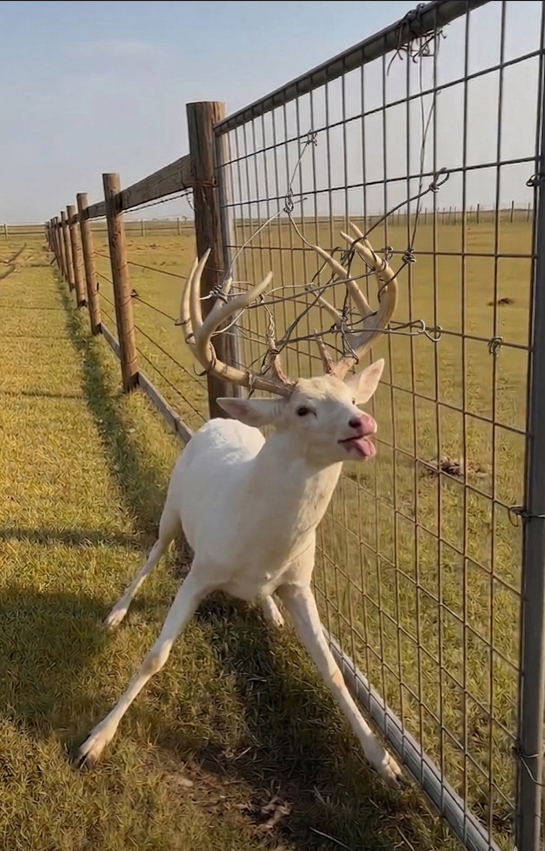
A deer. A white deer. A full-grown buck with a wide, heavy rack of antlers — tangled deep into the wire mesh of the fence. His front half was on one side. His back legs were on the other. His antlers were woven through the wire in at least four places, twisted and locked so tightly that the metal had bent around the bone.
He was on his knees. His front legs were folded beneath him, pressed into the dirt. His back legs were stretched out behind him at an angle that looked wrong — the kind of angle that happens when an animal has been pulling in one direction for so long that its body has shifted into a position it was never meant to hold.
His tongue was out. His mouth was open. His sides were heaving — fast, shallow breaths that moved his whole ribcage. His eyes were wide and glassy, staring at nothing, locked in that empty space between panic and surrender where an animal goes when it has used up everything it has and there is nothing left to burn.
Dale turned off the engine. The silence hit him like a wall.
He Had Been There All Night
The ground told the story. Around the base of the fence, the grass was torn up in a wide circle — hooves had churned the dirt into a mess of mud and roots and scattered tufts of green. Deep grooves ran through the soil in every direction, marking every lunge, every twist, every desperate attempt to rip free.
The wire around his antlers was bent and stretched but not broken. Each time he had pulled, the mesh had flexed and bounced back, and his antlers — wide, branching, covered in velvet — had only driven deeper into the grid. Every struggle made it worse. Every movement tightened the trap.
There were marks on the wooden post nearest to him — long vertical scratches where his hooves had kicked against the wood. Some of the scratches were deep. Some were faint. The deep ones came first, when he still had the strength to fight. The faint ones came later, when the fight was leaving him.
Dale had been ranching for thirty-one years. He had pulled calves from mud, cut bulls from barbed wire, freed a horse that had gotten its leg between two fence rails during a storm. He had seen animals trapped before.
But he had never seen anything like this.
The White Buck
Everyone in the county knew about the white deer. He had been spotted for the first time about three years ago — a young buck, pure white from nose to tail, moving through the fields at the edge of the tree line like something out of a story that no one would believe unless they saw it themselves.
People drove out to the back roads just to catch a glimpse of him. Farmers would see him at dawn, standing in the open pasture like a ghost made of bone and light. Kids talked about him at school. Hunters — the ones with any sense — left him alone. Not because it was illegal, though in some places it was. Because shooting him felt like something you just did not do.
He was rare. Not albino — his eyes were dark, not pink. A genetic condition called leucism, where the pigment fades from the fur but the eyes stay normal. It happens in maybe one out of every twenty thousand deer. Some say fewer. He was the only white deer anyone in Linden had ever seen.
And now he was on his knees in the dirt with his antlers locked in a wire fence and his body shutting down.
Getting Close
Dale called his neighbor, Ray, first. Then the county wildlife line. Then his son, who lived twenty minutes east and had a pair of bolt cutters in his garage that were better than anything Dale owned.
While he waited, he walked toward the deer. Slowly. One step every few seconds. Hands at his sides. No sudden movements. No sound except his boots pressing into the grass.
The buck saw him coming. His ears flattened. His nostrils flared wide. A tremor ran through his body — that deep, involuntary shudder that happens when an animal's nervous system fires one last warning to run.
But he could not run.
His legs twitched. His shoulders tensed. His body tried — every muscle, every tendon, every fiber that still had anything left — tried to launch itself forward and away and free. But the antlers held. The wire held. The fence did not move. And after a few seconds, the effort drained out of him like water from a cracked glass, and he went still again.
Dale stopped about eight feet away. He crouched down. Low. Below the deer's eye line. And he waited.
He did not speak at first. He just sat in the dirt and let the animal look at him. Let it process his presence. Let its heart rate come down from whatever impossible number it had reached.
Then, quietly, in the same voice he used with newborn calves when they were scared and cold and did not understand the world yet, he started talking.
Nothing important. Nothing that mattered in terms of words. Just a steady, low, even stream of sound that said: I am here. I am not going to hurt you. We are going to get you out of this.
Cutting Him Free
Ray arrived first. Then Dale's son, Kevin, with the bolt cutters. The three of them stood by the truck for a minute, looking at the deer, working out a plan without saying much. There was not much to say. The job was clear. The risk was clear too — a panicked buck with a rack that wide could break a jaw or crack a rib if it swung its head at the wrong moment.
Kevin approached from the left side, staying low, moving in a wide arc so the deer could see him the entire time. Ray positioned himself on the right, holding a thick blanket they would use to cover the buck's eyes if he started to panic. Dale stayed in front, talking, keeping his voice steady, keeping the animal's attention on something calm.
Kevin started cutting.
The first wire snapped with a sharp metallic sound that made the buck flinch. His whole body jerked. His legs kicked once — hard — sending a spray of dirt into the air. Then he settled. His breathing was still fast, but his eyes shifted toward Kevin. Watching. Processing.
The second wire. The third. Each one released a small section of antler, giving the buck a fraction more room to move his head. With every cut, the tension in his neck loosened. His head dropped slightly lower. His breathing slowed — not by much, but enough to notice.
It took fourteen cuts. Fourteen individual wires, each one carefully selected to release the antler without collapsing the fence section or causing the remaining wires to snap and tighten around his face. Kevin worked slowly. Precisely. Wiping sweat off his forehead between cuts even though the morning air was cool.
The last wire held the main beam of the left antler — the thickest branch, the one that had driven deepest into the mesh. Kevin positioned the cutters, looked at his father, and squeezed.
The wire snapped.
The buck's head came free.
He Did Not Run
That was the part none of them expected.
His antlers were clear. The wire was gone. Nothing was holding him. His legs were underneath him. The field was open behind him — miles of grass and tree lines and freedom in every direction.
But he did not run.
He stayed on his knees for a long time. Ten seconds. Twenty. His head hung low, almost touching the ground. His sides still heaved, but slower now. His tongue slowly pulled back into his mouth. His eyes blinked — once, twice — and something shifted in them. Something came back. A light. A focus. A recognition that the wire was no longer there.
Then, slowly — painfully slowly — he straightened his front legs. Planted them. Pushed. His body rose, swaying, unsteady, like a building finding its balance after an earthquake. His back legs followed. He stood.
He was enormous. Standing, free of the wire, you could see just how large he was — tall, broad-chested, with a rack of antlers that spread wide enough to cast a shadow on the grass. His white coat was streaked with dirt and mud and sweat, but underneath it he was still the same animal that had made people pull their trucks over just to watch him walk across a field.
He turned his head and looked at the three men standing by the fence. Not with fear. Not with the blank, empty stare he had worn when Dale first found him. Something else. Something quieter.
Then he walked. One step. Two. Testing his legs. Finding his balance. Each step a little steadier than the last. He crossed the grass toward the tree line at the far edge of the pasture, moving slowly, his white body growing smaller against the yellow field.
He stopped once. At the edge of the trees. He turned his head back toward the fence — toward the torn wire and the churned dirt and the three men who were still standing there watching him — and held the look for a long time.
Then he stepped into the shadows and was gone.
What They Left Behind
The three of them stood at the fence for a while after that. Nobody moved to the truck. Nobody checked their phone. They just stood there, looking at the spot where the deer had disappeared, holding something between them that none of them had the right words for.
Ray was the first to speak.
"Thirty years I've been out here. That's the closest I've ever been to that deer. Didn't think I'd ever touch the same ground as him."
Kevin rolled up the cut wire and stuffed it in his jacket so no other animal would get caught in it. Dale walked the fence line for another hundred yards in both directions, checking for loose mesh, tightening what he could, marking what needed repair.
They did not talk about it much that day. But in the weeks after, each of them told the story at least a dozen times — to wives, to friends, to people at the feed store and the diner and the gas station on Route 6.
And every single time, they told it the same way. Not starting with the rescue. Not starting with the wire or the bolt cutters or the fourteen careful cuts.
They started with the moment he looked back.
Why This Matters
White deer are among the rarest animals in North America. Most people will never see one in their lifetime. They exist at the edges — of fields, of forests, of the stories people tell each other when they are trying to describe something that felt more important than it should have.
But they face the same dangers as every other wild animal. Fences. Roads. Wire. The infrastructure of human life that cuts through their world in straight lines they do not understand and cannot navigate.
This buck survived because one man was driving a fence line on a Thursday morning and noticed something white against the wire. Because he made a phone call. Because two other men showed up with the right tools and the patience to use them carefully. Because all three of them understood that some things are worth stopping for.
Not every trapped animal gets that chance. Not every fence line gets checked. Not every flash of white in the corner of your eye makes you slow down and look twice.
But when it does — when you stop, and you look, and you find something alive that should not still be alive — what you do next is the only thing that matters.
This deer is still out there. People still see him sometimes — at dawn, at dusk, moving through the fields like a quiet secret the land is keeping. He is older now. His rack is wider. His white coat still catches the light in a way that makes you hold your breath even when you have seen it before.
He walks a little differently than he used to. A slight hesitation in his step when he approaches a fence line. A pause. A moment where he stands and looks at the wire before deciding which way to go.
He remembers.
And somewhere on a farm outside Linden, Nebraska, three men remember too.