She was five months old. The growth weighed almost as much as she did. And every single person on that street had decided she wasn't their problem.
The Puppy on Decatur Street
In Macon, Georgia, on a cracked stretch of sidewalk behind a row of auto shops and check-cashing stores, a puppy was dying in plain sight.
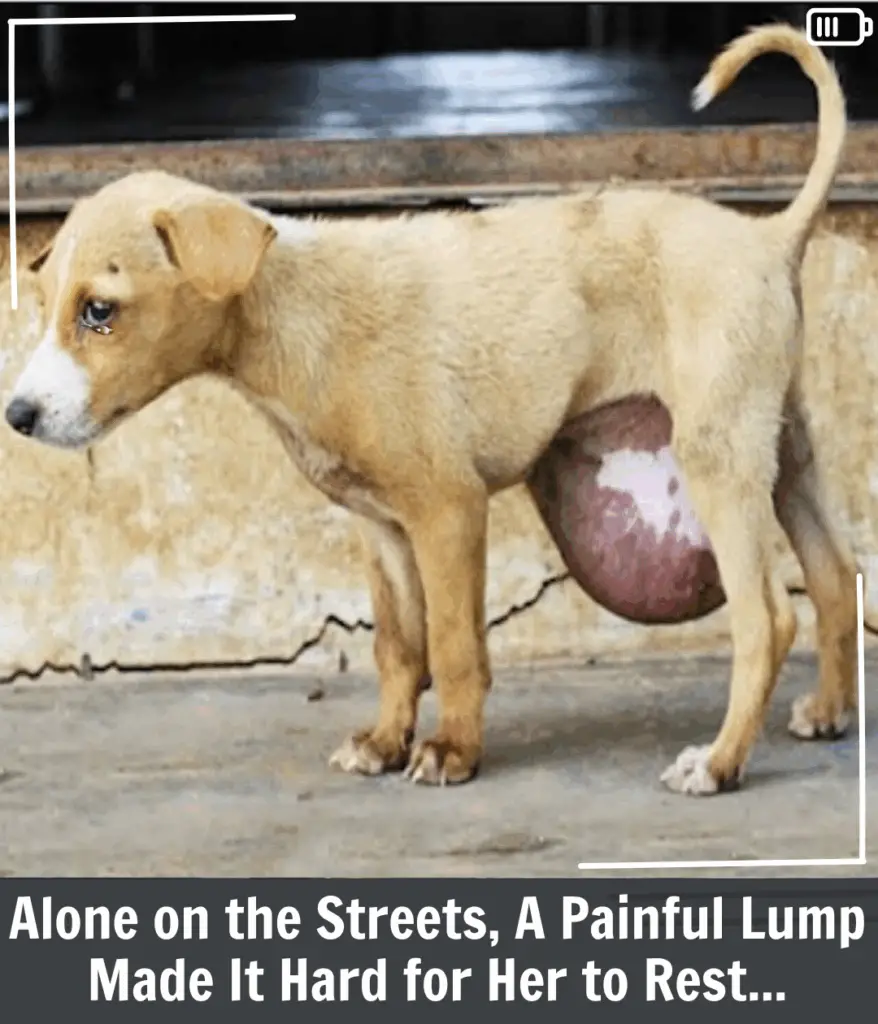
She was small — maybe twelve pounds, tan and white, with soft ears that folded forward and ribs you could count from ten feet away. She looked like any other stray you'd see near a dumpster in the South. Thin. Cautious. Invisible.
Except for the mass.
Hanging from her lower abdomen was a growth the size of a cantaloupe. Swollen, hairless, stretched so tight the skin had turned purple in places. It hung so low it nearly touched the ground when she stood. When she tried to walk, she had to swing her back legs wide — a slow, painful waddle that covered maybe three feet before she'd stop, panting, and lower herself back to the concrete.
She had been there for weeks.
The owner of the tire shop across the street said he'd seen her for at least a month. The woman who ran the laundromat two doors down said she'd been putting out water for her since March. The guy at the gas station on the corner said he'd called animal control twice and nobody came.
Everyone knew she was there. Everyone saw the growth. Everyone had a reason they couldn't do more.
Natalie Didn't Have a Reason Either — She Just Stopped
Natalie Sims was a 29-year-old dental hygienist who was driving through Macon on her way to visit her sister in Atlanta. She had no connection to the area. No rescue experience. No plan.
She stopped at the gas station to fill up. While the pump ran, she walked to the sidewalk to stretch her legs. And there, lying in the shade of a broken newspaper box, was the puppy.
"I thought she was dead," Natalie said. "She was so still. Then I saw her chest move and I walked closer and I saw — I saw the thing hanging off her and I just... I couldn't process it. My brain couldn't make sense of what I was looking at. It was bigger than her head. She was a baby and she had this thing hanging off her that looked like it weighed five pounds."
Natalie knelt down. The puppy didn't run. She didn't even lift her head. She just looked up with one eye — the other was crusted half-shut — and her tail moved. Once. A single, weak thump against the concrete.
"That tail wag destroyed me," Natalie said. "She was in that much pain and she still wagged her tail when a stranger got close. Like she was grateful someone was even looking at her."
Natalie picked her up. The puppy weighed almost nothing — but the mass was heavy, solid, warm to the touch. She carried her to the car, laid her on a towel in the passenger seat, and started searching for the nearest emergency vet.
The Diagnosis That Changed Everything
At Macon Veterinary Emergency Center, Dr. James Hadley took one look and brought the puppy straight to imaging.
The initial fear was a tumor — a massive, aggressive growth that would likely be inoperable in a dog this young and this malnourished. The staff was already preparing Natalie for the worst.
Then the ultrasound came back.
"It wasn't a tumor," Dr. Hadley said. "It was an inguinal hernia — one of the largest I've ever seen in a canine patient. Her abdominal wall had a defect, likely congenital, and over time her intestines, part of her bladder, and a section of fatty tissue had pushed through the opening and collected in a sac beneath the skin."
In plain terms: her insides were on the outside. And they had been for months.
The growth wasn't cancer. It was her own organs, trapped in a pouch of stretched skin, pressing against her legs, cutting off circulation, and slowly crushing the tissue inside.
"Without surgery, the herniated organs would have lost blood supply completely," Dr. Hadley explained. "We're talking tissue death, sepsis, organ failure. She had days — maybe a week. If she'd been out there much longer, we wouldn't be having this conversation."
Five Hours on the Table
The surgery was scheduled for the next morning. Natalie stayed overnight in the parking lot.
At 7 AM, the puppy — still unnamed — went under anesthesia. Dr. Hadley and his surgical team opened the hernia sac and began the slow, painstaking process of identifying each displaced organ and returning it to the abdominal cavity.
It took five hours.
The hernia sac contained nearly two feet of intestine, a portion of her bladder wall, and a mass of omental fat that had fused to the inner lining of the skin. Some of the tissue was necrotic — already dying from restricted blood flow. Dr. Hadley removed what couldn't be saved and repaired what could.
The abdominal wall defect was closed with surgical mesh. Two infected teeth were extracted while she was under. A drain was placed to prevent fluid buildup. And the stretched, damaged skin where the growth had hung was carefully trimmed, sutured, and bandaged.
When the puppy came out of surgery, she weighed eight pounds. The herniated mass had accounted for nearly a third of her total body weight.
"She'd been carrying that her entire life," Dr. Hadley said. "Every step she took, every time she tried to lie down, every time she tried to eat — that mass was pulling on her, pressing on her organs, causing constant pain. And she was still wagging her tail. I don't understand it. But I've seen it before. The ones who suffer the most are often the ones who still try the hardest to trust people."
The Name
Natalie named her Journey.
"Because that's what she'd been on," Natalie said. "A journey nobody should have to take alone. And she took it alone for five months on a sidewalk where everybody could see her and nobody picked her up."
Recovery — The Hard Part
Journey spent nine days in the ICU. The first three were critical — the surgical team monitored for signs of sepsis, internal bleeding, and organ rejection. She was on IV fluids, antibiotics, and pain medication around the clock.
On day two, she stood up. Her legs buckled — she'd spent months compensating for the weight of the hernia, and now that it was gone, her body didn't know how to balance. She fell twice. The third time, she stayed up for four seconds before sitting back down.
A vet tech recorded it. The video got 2 million views in 48 hours.
On day five, she walked across the recovery room. Not the wide, painful waddle from before — an actual walk. Straight line. Head up. Ears forward. She walked to the door, sniffed it, and looked back at the tech like she was asking what was on the other side.
On day seven, she ate a full meal without stopping. Boiled chicken, rice, a spoonful of pumpkin. She cleaned the bowl and then licked the floor around it for another thirty seconds.
On day nine, Natalie came to pick her up. Journey saw her from across the room and her entire back half started moving — not just her tail, her whole body. She wiggled so hard she knocked over a water bowl. Then she ran — ran — across the tile floor and jumped into Natalie's arms.
"She'd never run before," Dr. Hadley said, watching from the doorway. "In her entire life, she had never been able to run. That was her first time."
Natalie was crying too hard to speak.
The Bill
The surgery, ICU stay, medication, and follow-up care totaled $7,400.
Natalie didn't have it. She'd already put $2,000 on a credit card for the emergency intake and imaging. She set up a fundraiser the night of the surgery with a $5,000 goal.
It hit $5,000 in six hours. It hit $12,000 in two days. It hit $31,000 in a week.
Natalie paid Journey's bill. Then she donated the remaining $23,600 to the Macon Veterinary Emergency Center's stray animal fund — a program that covers surgery for rescued animals whose owners can't afford treatment.
"Journey paid for the next fifty dogs," Dr. Hadley said. "Her story funded surgeries for animals who would have been euthanized. She saved herself and then she saved others. That's not a metaphor. That's what actually happened."
Where She Is Now
Journey lives with Natalie in Savannah, Georgia. She's twenty-two pounds — a healthy weight for her frame. Her fur grew back thick and golden where the hernia sac used to hang. The scar is still visible if you look, but you have to look hard.
She runs every morning. Full sprints across the backyard, ears flapping, tongue out, crashing into the fence because she hasn't figured out braking yet. She sleeps on Natalie's bed — dead center, fully spread out, taking up more room than a dog twice her size.
She still wags her tail at strangers. Every single one.
"People ask me why I stopped that day," Natalie said. "I don't have a good answer. I wasn't looking for a dog. I wasn't on a rescue mission. I was getting gas. I just — I looked down. That's it. I looked down and I saw her and I couldn't unlook."
She paused.
"Everybody on that street saw her. For a month. They saw her dragging that thing across the ground and they walked around her. I'm not judging them. I probably would have done the same thing on a different day. But on that day, I didn't. And now she runs."
Five months on a sidewalk. One growth the size of her head. A hundred people who walked past. And one who didn't.
If this story made you feel something, share it. Because right now, on a street somewhere, there's a dog with something wrong that everyone can see and nobody is fixing. All it takes is one person to stop. Be that person.