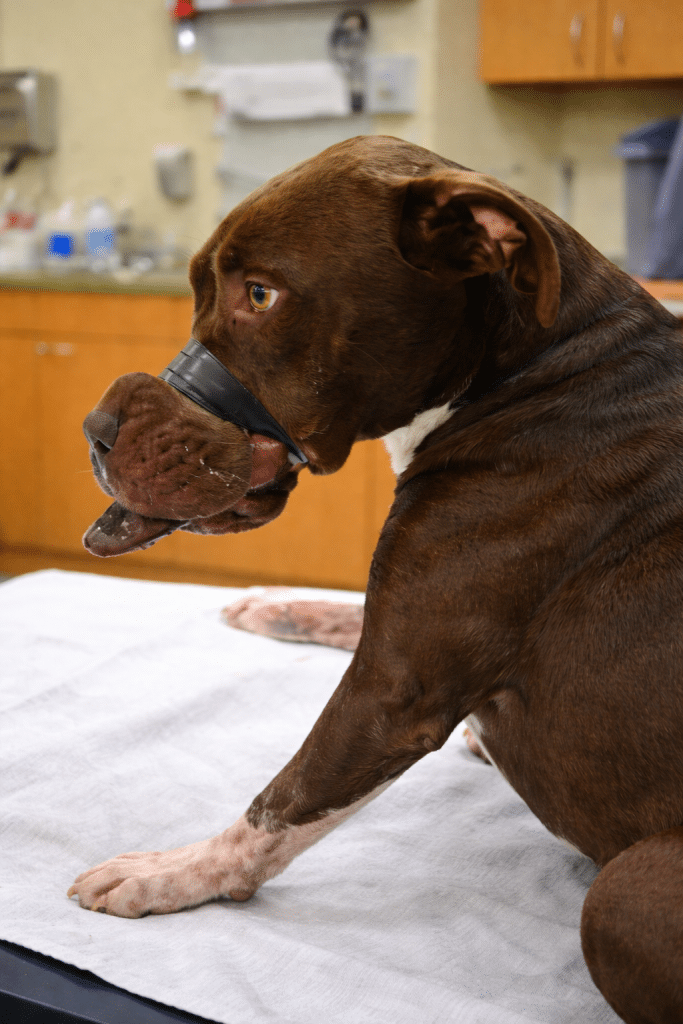
The photograph circulated for three days before most people could bring themselves to look at it directly. A young dog, maybe two years old, found on a roadside in North Charleston with electrical tape wound so tightly around her muzzle that the tissue beneath had begun to die. Her face was swollen to twice its normal size. Her eyes were open but unfocused, as if she had gone somewhere else inside herself to survive what was happening to her body. The image was shared 2.4 million times in seventy-two hours. And then, as these things go, the world moved on to the next outrage. But Caitlyn did not move on. Caitlyn was still lying in a veterinary ICU, breathing through a tube, with dead tissue being carefully cut away from her face. Her story was just beginning.
The First Forty-Eight Hours
The animal control officer who responded to the call — a woman named Melinda Petros who had been working the North Charleston district for nine years — told me later that she almost did not recognize what she was looking at. The dog was lying in a drainage ditch behind a row of rental units on Hagood Avenue. From a distance, Melinda thought it was a bag of garbage. It was July, and the heat that week had been brutal — 98 degrees with humidity that made it feel like 107. When she got closer and realized it was a dog, and then realized what had been done to the dog's face, she sat down on the curb and put her head between her knees for a full minute before radioing in.
At the emergency veterinary clinic, the team worked for four hours that first night. The tape had been on for an estimated five days. Beneath it, the skin and muscle tissue of Caitlyn's muzzle had been deprived of blood flow for so long that portions had already necrotized. Her tongue was swollen and purple. She could not close her mouth fully. She was severely dehydrated — in July heat, with her mouth sealed shut, she had been unable to drink for nearly a week.
Dr. Lucy Kuo, the emergency veterinarian on shift, told me that the first priority was simply keeping Caitlyn alive through the night. They placed an IV line, administered pain medication and antibiotics, and began the delicate process of removing dead tissue without damaging the viable skin beneath. Caitlyn was conscious for parts of this. She did not struggle. She did not make a sound. She just lay there, breathing through the tube they had placed, staring at the ceiling with those same distant eyes from the photograph.
Lucy said she went home at 3 AM that night and could not sleep. She sat in her kitchen and cried for twenty minutes, then got back in her car and drove back to the clinic to check on her patient. Caitlyn was in the same position, still staring at nothing. Lucy pulled a chair next to the kennel and stayed until morning.
The Months Nobody Saw
The surgeries came in stages. Three in the first month alone — debridement, grafting, reconstruction. Caitlyn's muzzle would never look quite normal again. The scar tissue formed thick and uneven, pulling slightly at the left side of her upper lip. But the tissue was healthy. It was alive. It was hers.
The physical healing, though — that was the easier part. What took longer was everything else. For the first six weeks at the rescue facility, Caitlyn would not let anyone touch her face. Not her chin, not her ears, not anywhere near her muzzle. A hand moving toward her head made her freeze completely — not flinch, not duck, just freeze. Every muscle locked. Eyes wide open. Breathing stopped. Like she was waiting for something terrible to begin again and had learned that stillness was the only protection available to her.
A behavioral specialist named Marcus worked with her three times a week. He told me that the first two weeks, he just sat in her kennel and read a book. Did not look at her. Did not reach for her. Did not speak to her unless she approached first. On day nine, she sniffed his shoe. On day fourteen, she lay down three feet from him instead of pressing herself against the far wall. On day twenty-two, she put her chin on his knee for four seconds, then pulled away like she had surprised herself.
Marcus said: "Recovery from this kind of trauma is not linear. It is not like a wound healing from the outside in. It is more like a conversation. You say something small — I am here, I am not going to hurt you — and then you wait. Sometimes you wait days for a response. Sometimes the response is a step backward. You have to be okay with that. You have to let her decide the pace."
The Day the City Showed Up
It happened on a Tuesday in late November, four months after the photograph. The mayor's office had been in contact with the rescue organization for weeks, coordinating something that had never been done before in North Charleston. They wanted to honor Caitlyn — not with a plaque or a proclamation that would sit in a drawer, but with something public. Something that said: we saw what happened to you, and we chose a different response than looking away.
The ceremony was held on the steps of City Hall. There were maybe two hundred people there — rescue volunteers, veterinary staff, city council members, and a large number of people who had simply seen the date posted online and driven in. Caitlyn arrived in a harness with Marcus walking beside her. She was calm. Her tail was moving — not frantically, but steadily, a slow back-and-forth sweep that Marcus told me meant she felt safe but alert. Aware of the attention but not threatened by it.
The mayor presented her with an honorary recognition — not a key to the city, which they discussed and rejected as too performative, but a framed certificate and a commitment: the city would fund twenty additional animal cruelty investigation hours per month, permanently, in Caitlyn's name. It was real. It had a budget line. It would result in more officers in the field, more cases investigated, more animals found before things went as far as they had gone with her.
Caitlyn sat through the short speech with her ears slightly forward. When people clapped, she did not startle. When the mayor knelt down to present the certificate — holding it near her, not touching her face — she leaned forward and sniffed it once, then looked up at Marcus. Her tail wagged a little harder. That was the photograph that went viral the second time. Not the one of her suffering. The one of her sitting calmly on the steps of a building full of people who had shown up for her, looking like she was exactly where she was supposed to be.
Tennis Balls and Ordinary Joy
After the ceremony, the rescue team took Caitlyn to a fenced field behind the community center. Someone had brought a bucket of tennis balls — old ones, slightly deflated, the kind that are perfect for chewing. They tossed one into the grass and Caitlyn watched it bounce. Then she ran after it. Not tentatively. Not cautiously. She sprinted. Full speed, ears back, mouth open, the kind of running that dogs do when they have completely forgotten everything except the ball and the grass and the air moving past them.
She brought it back. They threw another. She brought that one back too. For twenty minutes, she ran and retrieved and dropped and waited and ran again, and every single person watching was quiet in the specific way that people get quiet when they are seeing something they will remember for a long time.
Marcus was standing next to me during this. He did not say anything for a while. Then he said: "Four months ago she would not move from the corner of her kennel. She would not eat if someone was watching. She would not make eye contact with a person standing more than six feet away." He paused. "Look at her now." She was mid-sprint, ears flying, a tennis ball in her mouth and another one already being thrown.
The Fire Station Visit
Later that afternoon, they brought Caitlyn to Fire Station 11 on Rivers Avenue. This was not random — two of the firefighters at that station had been part of the initial response on the night she was found. They had helped transport her to the emergency clinic, held towels against her swollen face, talked to her in low voices during the twenty-minute drive when everyone in the vehicle was trying very hard not to fall apart.
One of them, a man named Terrell, had visited her twice at the rescue facility during her recovery. He never talked about it publicly. He just showed up on his days off, sat with her for an hour, and left. When Caitlyn walked into the station bay and saw him, she pulled toward him on the leash — not aggressively, not anxiously, but with clear intent. She knew him. She walked directly to where he was kneeling, pushed her head against his chest, and stayed there.
Terrell put his arms around her very gently — not near her face, just around her shoulders — and closed his eyes. Neither of them moved for maybe thirty seconds. Nobody took a photo. Several people looked away to give them the moment. Marcus told me later that Caitlyn had never done that with anyone else. Never initiated that kind of sustained, full-body contact. She chose it, with the specific person she chose, and that was its own kind of testament.
What Came After
Caitlyn went into foster care with a family in Mount Pleasant — a couple with no other pets and a fenced backyard and the kind of patient, quiet household energy that Marcus recommended. She has been there for five months now. She sleeps on a bed in the living room. She has a basket of toys she rotates through — always a tennis ball in reach. She goes for walks twice a day, and she has started greeting the neighbors' dogs through the fence with her tail wagging rather than pressing herself against her handler's leg.
She still does not like hands near her face. That may never change completely. Her foster family knows not to reach over her head, not to touch her muzzle, not to move quickly in her peripheral vision. These are small adjustments. They do not diminish her life. They are simply part of who she is now — part of the map of her experience, written into her responses in ways that may always be there, like scar tissue beneath fur.
The criminal case against the man who did this to her is still pending. I am not going to write his name here. This is not his story.
This is the story of a dog who survived something unsurvivable, and a veterinarian who drove back to the clinic at 3 AM because she could not leave her alone, and a behavioral specialist who sat reading a book in a kennel for two weeks waiting for a chin on his knee, and a firefighter who visited on his days off and never told anyone, and a city that decided to do something real instead of something symbolic. It is the story of what happens when people choose, again and again, to show up. Not once for the viral moment. But every day after, when no one is watching, for as long as it takes.