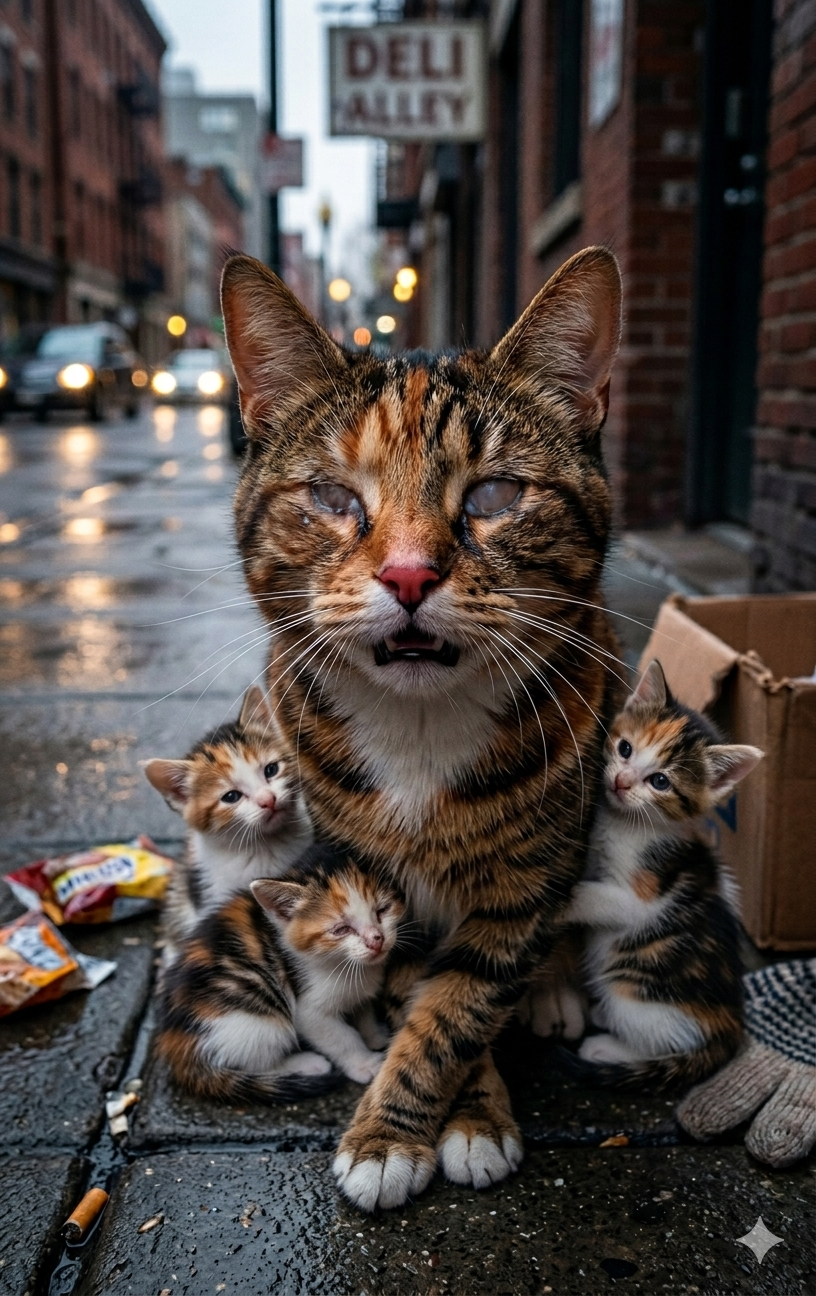
The alley smelled like wet cardboard and engine oil. Rain had come and gone three times that day, and the puddles between the cobblestones hadn't dried yet. Halfway down, between a dumpster and a stack of broken pallets, a mother cat sat with her back against the bricks. Three kittens were tucked beneath her. Her body was curled around them like a wall. Her eyes were open. But they saw nothing.
The World She Couldn't See
Her eyes were cloudy — both of them — covered in a thick, milky film that turned the world into a blur of shadows and light. She had been losing her vision for months. First the edges went soft. Then the colors faded. Then one morning she woke up and the world was gone.
She was a calico. Orange and black and white, though her coat was dull now from months of malnutrition. Her whiskers were long and bent from pressing them against walls and curbs, using them the way a blind person uses a cane. Every surface she touched told her something. Every vibration through the ground was a message.
She had learned to navigate by memory and sound and smell. The dumpster on the left meant food scraps sometimes appeared nearby. The hum of a generator on the right meant warmth. The rumble of trucks meant danger — move the kittens deeper into the alley.
She couldn't see any of it. But she knew all of it.
Three Lives That Depended on Her
The kittens were barely five weeks old. Two calicos like her, and one orange tabby with white paws. They were small — too small for their age. Their ribs showed beneath their fur, and their eyes were too big for their faces, the way hunger makes everything look sharper and more desperate.
They didn't know their mother was blind. They only knew that she was always there. That she always pulled them closer when the wind picked up. That she always positioned herself between them and the opening of the alley, facing outward, ears rotating like satellites even though her eyes were useless.
The smallest one — the orange tabby — had a habit of crawling over her mother's paws and wandering a few feet away. Every time she did, the mother's head would snap in that direction. Not because she could see movement. Because she could hear the tiny footsteps moving away from the group.
She would reach out her paw, sweep the ground in front of her, and pull the kitten back. Every single time. Even when her body was shaking from exhaustion. Even when she hadn't eaten in two days.
How She Fed Them
Hunting blind is not hunting. It is something closer to prayer. You wait. You listen. You hope that something edible lands close enough to smell, close enough to reach, close enough that your broken body can still get to it before it's gone.
She would wait until the kittens were asleep, pressed together in a pile of warmth and small breathing. Then she would stand up — slowly, carefully, testing the ground with each step — and follow the wall of the alley toward the street.
She walked with her shoulder brushing the bricks, counting steps the way she always did. Fourteen steps to the corner. Six more to the edge of the sidewalk. Then the terrifying open space where cars moved fast and the ground vibrated beneath her paws.
She found food the way she found everything — by smell. Old chicken bones near a takeout place. A torn bag of trash with rice still stuck to the container. Half a hot dog someone had dropped near a street cart. She ate fast, not because she was greedy, but because every second away from the kittens was a second they were unprotected.
Then she would turn around and walk back. Fourteen steps. The dumpster. The pallets. The kittens.
She would lie down beside them, and they would wake up and press against her, and she would lick each one with a rough, slow tongue. Cleaning them. Counting them. Making sure all three were still there.
The Night She Almost Lost One
It happened during a rainstorm. The kind that turns alleys into rivers and pushes the cold straight through fur and skin and into bone.
The water rose fast. She felt it before the kittens did — a cold creep against her belly that told her they had to move. She grabbed one kitten by the scruff and carried it to a higher ledge near a basement window. Then she went back for the second.
But the third — the orange tabby, the wanderer — had already been pushed by the current. Not far. Just a few feet. But for a blind mother, a few feet is the other side of the world.
She searched. Her head swept left and right. Her paws splashed through the rising water. She meowed — a raw, desperate sound that echoed off the alley walls. She moved in a circle, widening it with each pass, feeling for the small body that should have been right there but wasn't.
She found her pressed against the base of a drainpipe. Cold. Soaked. Crying. She grabbed her by the scruff and carried her to the ledge where the other two were waiting.
Then she lay on top of all three of them, covering them with her body, shielding them from the rain with the only shelter she had.
Herself.
What People Saw
People walked past that alley every day. Most didn't look. The ones who did saw a stray cat and some kittens. They didn't see the cloudy eyes. They didn't notice the way she kept her body between the kittens and the street. They didn't understand that every movement she made — every head tilt, every ear twitch, every cautious step — was a blind mother navigating a world that gave her nothing, fighting to keep alive the only things that mattered.
One man tossed a piece of bread near her. She flinched at the sound. Her head turned toward it. She sniffed the air, found it, and pushed it toward the kittens with her nose before eating any herself.
He stood there for a moment. Then he kept walking.
The Woman Who Stopped
Her name was Rachel. She worked the early shift at a coffee shop three blocks away and walked through that alley as a shortcut. She had seen the cat before — a few times — but always from a distance. Always in a hurry.
On that Tuesday morning, she stopped. She didn't know why. Maybe it was the way the mother was sitting — perfectly still, facing the alley entrance, ears forward, body tense — as if she were guarding a door that nobody else could see.
Rachel crouched down about ten feet away. The mother's head turned toward her instantly. Not her eyes — her ears. Her nostrils flared. Her body stiffened. One paw moved slightly in front of the kittens.
Rachel looked at the mother's face. She saw the eyes. Cloudy. White. Unseeing.
And something in her chest broke.
She didn't try to touch them. She stood up, walked to work, and spent her entire shift thinking about a blind cat sitting in an alley with three kittens she would die for but couldn't even see.
That evening, she came back with a carrier, a blanket, a can of wet food, and the number of a rescue group saved on her phone.
The Rescue
It took four people, two hours, and more patience than most humans are capable of. The mother wouldn't let anyone near the kittens. Blind or not, she positioned herself in front of them and hissed with everything she had. Her ears were flat. Her back was arched. Her claws were out.
She couldn't see who was coming. She didn't know if it was a person or a dog or a car. All she knew was that something large was moving toward her babies, and she was going to stop it or die trying.
They used the food. They set it down. They waited. The mother sniffed. She was starving — her body was eating itself — but she didn't move. Not until the kittens had crawled forward and started eating first.
Only then did she lower her head and eat. Still facing outward. Still guarding. Still blind.
When the rescue volunteer finally got the blanket around her and lifted her into the carrier, she didn't fight. She went still. Completely still. As if she had used up every ounce of fight she had in the last five weeks and there was simply nothing left.
But when they placed the kittens in the carrier beside her, she pressed her nose against each one. Slowly. Deliberately. Counting. One. Two. Three. All there.
Then she closed her cloudy eyes and put her head down.
At the Clinic
The vet confirmed what everyone already knew. She was completely blind. Both eyes. Likely a combination of untreated infection and malnutrition that had damaged the optic nerves beyond repair. She would never see again.
She was also severely underweight. Dehydrated. Anemic. Her teeth were cracked. Her paw pads were raw and torn from navigating rough pavement by feel alone. She had a respiratory infection that made her wheeze with every breath.
The kittens were small but stable. Hungry, with mild flea anemia, but alive. All three of them. Because of her.
The vet tech who processed the intake wrote one line in the notes that the whole clinic would talk about later:
"Mother is blind. Kittens are in perfect condition. She gave them everything she couldn't give herself."
What Happened Next
It took six weeks of recovery. IV fluids. Antibiotics. Medicated eye drops for the infections, even though they couldn't restore her sight. Nutritional supplements. A heated bed that she never wanted to leave.
The kittens grew fast once they had consistent food. They tumbled and played and pounced on each other like kittens are supposed to. The orange tabby — the wanderer — was the first to climb out of the recovery pen and explore the room. The staff named her Compass, because she was always going somewhere new.
The mother spent her days lying on her side, listening to them play. Her ears followed their movements across the room. When one cried — even a small cry, even a playful one — her head lifted. Every time.
Rachel came back every weekend. She sat on the floor of the recovery room and let the kittens climb into her lap. The mother couldn't see her. But after a few visits, she recognized her footsteps. The way she walked. The sound of her jacket. And one day, when Rachel sat down beside her, the mother leaned her head against Rachel's hand and purred.
It was the first time the staff had heard her purr.
A Home She'll Never Have to Leave
Rachel adopted all four of them. The mother and all three kittens. She said she couldn't imagine separating them. She said the mother had spent her entire life keeping those kittens together, and she wasn't going to be the one who pulled them apart.
The mother — Rachel named her Grace — lives on a soft bed near the window now. She can't see the sunlight that falls across her face every morning, but she turns toward it anyway. She can feel it. And that is enough.
The kittens sleep around her every night. Even though they're older now, bigger, more independent. They still come back. They still press their bodies against hers. They still arrange themselves around her the same way they did in that alley, when she was all they had.
Grace can't see them. She has never seen them. She doesn't know what color their fur is or how big they've gotten or what they look like when they chase a toy across the living room floor.
But she knows them. She knows the sound of each one's footsteps. She knows which one purrs the loudest and which one sleeps the closest and which one still wanders a little too far and needs to be pulled back with a gentle paw.
She knows everything that matters. She always did.
Why This Story Stays With You
Because she didn't need to see them to save them. She didn't need vision to love them. She didn't need anything except the decision to keep going — one more day, one more hunt, one more cold night with her body wrapped around three small lives that the world had already forgotten.
She was blind. And she saw more clearly than most of us ever will.
She saw that love doesn't require sight. That motherhood doesn't require comfort. That protecting someone doesn't require knowing what's coming — only knowing that you'll stand in front of it anyway.
A blind cat in a dark alley. Three kittens who never knew she couldn't see them. A woman who stopped walking one Tuesday morning and changed everything.
That's all it took. One person who looked. One mother who never stopped fighting. And three small lives that exist today because a cat who couldn't see the world still refused to let the world take her children.