The call came into the county animal control line at 7:42 on a Tuesday morning. A truck driver named Greg Holloway, heading south on Route 9 toward the county line, reported a dog standing in the emergency lane near mile marker 34. Not crossing. Not wandering. Standing. Facing the oncoming traffic and barking. He said he almost hit her. He said she did not move.
Mile Marker 34
The volunteer who took the call was Rachel Simmons, a third-year veterinary student who had been working the morning shift at the rescue hotline for five months. She logged the report and flagged it as moderate priority — a stray near a highway was dangerous but common enough on that stretch of road. Then a second call came in twelve minutes later. A different driver, same location, same description. A medium-sized brown dog, standing in the breakdown lane, barking at traffic. The driver said she looked like she was guarding something.
Rachel upgraded the priority and dispatched a two-person field team: Marcus Webb, a full-time rescue coordinator who had been doing this work for six years, and Jen Torres, a volunteer on her second month. They left the shelter at 8:15 and reached the location at 8:47. What they found when they pulled onto the shoulder would stay with both of them for a long time.
The dog was standing exactly where the callers described — in the narrow gravel strip between the highway and a concrete drainage channel that ran parallel to the road. She was a mixed breed, maybe thirty pounds, brown with a white patch on her chest. Her fur was matted and filthy. Her ribs were showing. And she was barking — not the casual bark of a dog who sees something interesting, but a rhythmic, desperate, hoarse bark that sounded like it had been going on for hours. Her voice was nearly gone.
Marcus got out of the van slowly. The dog saw him and barked louder. Not at him. Past him. At the road. At the cars. At everything that was moving and none of it stopping. He took three steps toward her and she did something he did not expect. She turned away from the highway, walked four steps toward the drainage ditch behind her, looked down into it, and then looked back at him. Then she barked again.
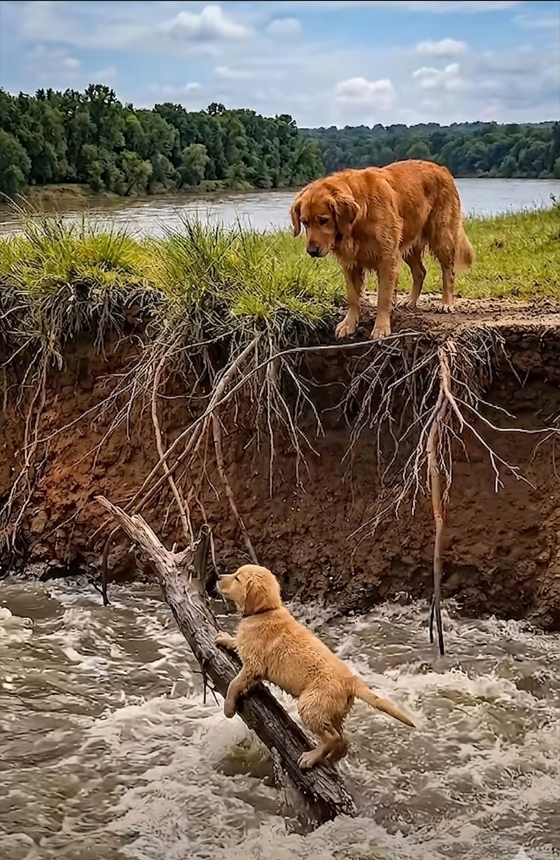
He walked to where she was standing and looked down. The ditch was about three feet deep, lined with cracked concrete and half-filled with stagnant water and debris. A section of old metal guardrail had collapsed into it at some point — maybe weeks ago, maybe months — creating a cage-like pocket of twisted steel and broken posts. Inside that pocket, pressed together on a narrow strip of dry concrete above the waterline, were five puppies.
What Was Happening in the Ditch
The puppies were small — Marcus estimated three to four weeks old. Their eyes were open but cloudy in the way that very young dogs' eyes are before they fully adjust. They were wet. They were shaking. Two of them were making faint sounds that were not quite whimpers and not quite cries. The other three were silent and still, though Marcus could see their sides moving with shallow breaths.
The metal debris around them was the problem. The guardrail section had fallen in a way that created a pocket just large enough for the puppies to huddle in, but too tight and too tangled for them to climb out. The mother could not get down to them — the angle was too steep and the metal too jagged. She could stand at the edge and look down. That was all. And based on the raw patches on her front paws where she had been digging at the gravel, she had tried everything else first.
Marcus called Rachel and told her to give Dr. Patterson's clinic a heads-up that they were bringing in five puppies and a mother, condition unknown, possible dehydration and hypothermia. Then he and Jen started working.
The mother dog would not leave the edge of the ditch. She stood two feet from Marcus the entire time, watching everything he did. She did not growl. She did not snap. She did not try to stop him. She just watched. And every thirty seconds or so, she looked down at the puppies and then back at Marcus, as if checking that the connection between the two was still intact. As if making sure he had not forgotten why he was there.
Getting Them Out
It took forty minutes. The guardrail was rusted but heavy, and the angle it had fallen at meant Marcus could not simply lift it. He used a pry bar from the van to bend back the two pieces that were creating the tightest part of the enclosure. Jen held a blanket stretched across the opening to keep the puppies from falling deeper into the water if they moved. The noise from the highway was constant — trucks passing at full speed, the ground vibrating with every one.
The first puppy Marcus reached was the smallest one. He lifted it with one hand and passed it up to Jen. It weighed almost nothing. Jen wrapped it in a towel and set it in a heated carrier they had brought from the van. The mother dog immediately walked to the carrier, sniffed the puppy through the mesh door, and walked back to the edge of the ditch. She looked down at the remaining four. She looked at Marcus. She barked once. A short, hoarse, single bark that neither of them had any trouble translating.
Keep going.
The second and third puppies came out together — they were pressed so tightly against each other that separating them in the tight space would have been harder than lifting them as a pair. The fourth was wedged under a bent section of post and took the longest. Marcus had to lie on his stomach at the edge of the ditch, reach down at full extension, and carefully slide the puppy out from under the metal while Jen held the post steady. His shirt was soaked through with ditch water by the time he got the puppy free.
The fifth puppy was the one that scared them. She was lying on her side at the far end of the pocket, away from the others, and she was not moving. Marcus reached her and touched her side. Cold. He picked her up and she was limp. He held her against his chest inside his jacket and climbed out of the ditch quickly. He told Jen to drive. He held the puppy against his body heat for the entire thirty-five-minute ride to the clinic and did not say a word the whole way.
The mother dog climbed into the van on her own. Nobody had to coax her. She stepped in, walked to the carrier where the first four puppies were huddled together under towels, lay down beside it, and put her chin on the floor of the van. She closed her eyes. She did not bark again for the rest of the drive.
At the Clinic
Dr. Patterson and his team were waiting when the van pulled in. The four puppies in the carrier were dehydrated and hypothermic but responsive. They were placed on warming pads, given subcutaneous fluids, and monitored. The smallest one — the first one Marcus had pulled out — was the weakest of the four but stable.
The fifth puppy was the emergency. Her body temperature was critically low. Her heartbeat was faint and slow. Dr. Patterson wrapped her in a warm towel, placed her on a heated pad, and administered warm fluids. For the first twenty minutes, there was no change. Marcus stood in the doorway of the treatment room and watched. He told me later that he had already started to accept that she was not going to make it. He had seen it before — puppies that young, that cold, that far gone.
At minute twenty-two, the puppy moved her front left paw. A tiny flex. Then nothing for five more minutes. Then she opened her mouth and made a sound so faint that Dr. Patterson almost missed it. He adjusted the warming pad and increased the fluid rate slightly. Fifteen minutes later, she lifted her head.
Marcus sat down on the floor of the hallway outside the treatment room and pressed his palms against his eyes. Jen brought him a coffee. He did not drink it. He just held it and stared at the wall for a while.
The Mother
The mother dog was examined after the puppies were stabilized. She weighed twenty-four pounds — underweight for her frame by at least eleven. She was severely dehydrated. Her paw pads were worn raw from standing on gravel and digging at the edge of the ditch. Her throat was inflamed from hours of barking. Her teats showed she was actively nursing, which explained her condition — she had been producing milk for five puppies on almost no food or water, while standing guard on the side of a highway.
Dr. Patterson estimated she had been there for at least two days based on her condition. Two days standing between her puppies and a highway. Two days barking at cars that did not stop. Two days without food, without water, without shade, without rest, nursing puppies she could hear crying below her but could not reach. She could have walked away at any point. She could have gone to find food, find water, find shelter. She chose not to.
They named her Mercy. Rachel chose the name. She said it was the only word that came to mind when she saw the intake photos — a dog who had nothing left to give and gave it anyway.
Three Weeks Later
All five puppies survived. The fifth one — the one Marcus held against his chest for thirty-five minutes in the van — was the slowest to recover but caught up to her siblings by week two. She is the loudest of the group now, which Marcus says makes complete sense because she had the most to make up for. They named her Echo.
Mercy gained nine pounds in the first three weeks. Her paws healed. Her bark came back, though she rarely uses it at the shelter. She sleeps in a large crate with all five puppies piled on top of her, and when volunteers come in for morning feeding, she lifts her head, counts the puppies with her eyes — one, two, three, four, five — and puts her head back down. Every morning. Every single morning.
Marcus told me that the part he keeps thinking about is not the rescue itself. It is the moment when the mother dog turned away from the highway, walked to the edge of the ditch, looked down at her puppies, and looked back at him. That single look. The way she connected him to them in one movement. She did not know if he would help. She did not know if he was safe. But she had been barking at every car for two days and this was the first one that stopped, and she was not going to waste the chance.
"She showed me her babies," he said. "She could not get them out. She could not carry them. She could not protect them from the cold or the water. The only thing she could do was stand there and call for help and hope that someone would listen. And when someone finally did, she did not hesitate. She walked right to that ditch and showed me exactly where they were. She had been waiting for me. Not me specifically. Anyone. She had been waiting for anyone who would stop."
He paused.
"I almost didn't stop," he said. "I was thinking about the other call we had that morning. I was thinking we would come back later. I almost drove past. I think about that every day."
Mercy and her puppies are available for adoption through the county shelter. She needs a home with a secure yard — she has a habit of standing at doors and windows, watching, as if the part of her that guarded the roadside never quite switched off. The puppies need homes where they will be kept together in pairs at minimum. They do not do well alone. They do not like being separated. They spent their first weeks of life pressed against each other in the dark, and they learned something there about staying close that they have not forgotten.