The house had been empty since October. The neighbors on Mirea Street assumed the dog was gone too — taken by a relative, maybe, or picked up by the city. Nobody checked. There was no reason to check. The old man who lived there had passed quietly, and the family had cleared the furniture within a week. The front door was locked. The windows were shut. There was nothing left inside. Except Marvin.
The House on Mirea Street
It was a postal worker who finally heard him. Not barking — Marvin had stopped barking weeks earlier. It was a low sound, something between a groan and a whimper, coming through the gap under the front door. The postal worker, a woman named Dana who had been delivering to that street for eleven years, stopped on the porch and listened. She told me later that she almost walked away. Almost convinced herself it was the pipes. But something about it made her kneel down and press her ear to the door.
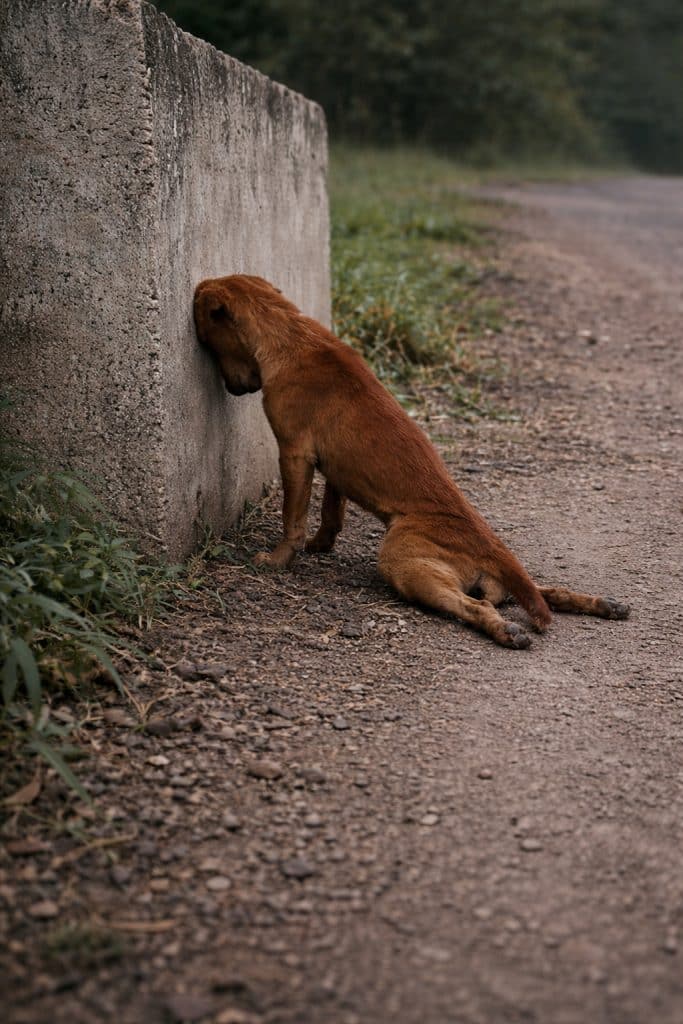
She called the local rescue organization, Stray Paws, at 9:14 that morning. By 10:30, a volunteer named Cosmin had arrived with bolt cutters. When they opened the side door, the smell hit them first — urine, rot, and something sweet and sour that Cosmin said he still remembers. The kitchen floor was covered in dried waste. The water bowl next to the refrigerator had been empty for what looked like a long time. There were scratch marks along the bottom of the back door, deep ones, from weeks or months earlier. And in the corner, pressed against the wall where the radiator used to be, was Marvin.
He was lying on his side. His ribs were visible through his fur. His hind legs were splayed out behind him at an unnatural angle, completely still. He did not lift his head when they came in. He just moved his eyes.
What They Found When They Examined Him
The veterinary team at the Stray Paws clinic weighed Marvin at 11.3 kilograms. For a mixed-breed dog of his frame — part shepherd, part something stockier — he should have been closer to 27. His gums were pale. His coat was falling out in patches. There were sores on his hips and elbows from lying on the hard floor for extended periods without being able to shift his weight properly.
The hind leg paralysis was the most serious finding. Dr. Elena Ardelean, the veterinarian who handled his intake, told me that the initial X-rays showed significant muscle wasting in both rear limbs. A neurological exam confirmed that he had limited deep pain sensation below the lumbar spine. The working theory was that a disc had herniated or degenerated — possibly from a fall, possibly from age, possibly from something that had happened before his owner died. There was no way to know exactly when it started. What they did know was that he had been lying on that floor, unable to stand, for a very long time.
He was dehydrated. His kidneys were stressed. His blood work showed the kind of numbers you see in a dog whose body has been consuming its own muscle tissue for fuel. Elena told me that when she first looked at the results, she was not sure they could save him. She said she sat in her office for ten minutes before going back out to talk to the team.
What she told them was: we try.
The First Two Weeks
They started with fluids and nutrition. Marvin could not eat solid food at first — his stomach had shrunk so much that anything more than a few tablespoons made him vomit. They fed him a recovery paste, a little bit every two hours, around the clock. A volunteer named Ioana took the night shifts for the first five days. She told me she would sit on the floor next to his crate with her phone light on, spooning paste onto her finger and letting him lick it off.
He did not trust them. Not at first. When anyone reached toward him, he flinched. Not aggressively — he never growled, never snapped. He just closed his eyes and turned his head away, like he was bracing for something. Ioana said that was the part that got to her. Not the physical condition, as terrible as it was. It was the flinching. The way he had learned to expect that a hand coming toward him meant nothing good.
By day four, he stopped flinching when Ioana reached for him. By day seven, he was eating soft food from a bowl. By day ten, he licked her hand for the first time. She cried in the parking lot afterward and called her mother.
Learning to Move Again
The physical therapy started in week three. A canine rehabilitation specialist named Bogdan drove two hours from the city twice a week to work with Marvin. The first sessions were painful to watch. Bogdan would support Marvin's hindquarters with a sling while encouraging him to engage his front legs. Marvin would try, strain, shake, and then collapse. Over and over.
They brought in a small wheelchair — a four-wheeled cart that strapped around his chest and held his back end off the ground. The first time they put him in it, he did not move. He just stood there, supported by the frame, staring at the ground. Bogdan waited. Five minutes. Ten. Then Marvin took one step with his front right paw. Then another. Then he stopped again and looked up at Bogdan with an expression that everyone in the room interpreted the same way: is this allowed?
Within a week, he was rolling through the clinic hallway in the wheelchair. Slowly, unsteadily, bumping into walls. But moving. Choosing to move. Ioana started taking him outside in the chair for ten minutes each afternoon. He would sit in the grass and smell the air, and his tail — which had not moved since the day they found him — started to wag. Just a little. Just at the tip.
The hydrotherapy began in week five. They used a small pool with a ramp and a warm water temperature that helped relax his muscles without putting pressure on his joints. The first session, he panicked. The second session, he tolerated it. By the fourth session, he was paddling with his front legs and — this is the part Elena could barely tell me without her voice cracking — he was making small, involuntary kicking motions with his back legs. Not controlled. Not purposeful. But present. The nerves were not completely dead.
The Night He Stood Up
It happened on a Thursday, seven weeks after they had carried him out of the house on Mirea Street. Ioana was doing the late evening check. Marvin was in his crate with the door open — he had long since stopped needing it closed. She was filling water bowls down the row when she heard a sound behind her. A clicking. Nails on tile.
She turned around and Marvin was standing. Not in his wheelchair. Not supported by anything. His back legs were shaking badly and his stance was wide and awkward, but he was bearing weight on all four legs. He took one step. Then another. Then two more. Four steps total. Then his back legs buckled and he went down.
Ioana did not move. She stood in the hallway holding a water jug and stared at him. He looked back at her from the floor, and his tail was wagging — really wagging, not just the tip — and she said she started laughing and crying at the same time and could not stop for several minutes.
She called Elena at home. Elena called Bogdan. By morning, the entire team knew. They adjusted the therapy plan immediately — more weight-bearing exercises, longer hydro sessions, a graduated schedule to build the muscles that had just proven they could still fire.
Three Months Later
Marvin cannot run. He probably never will. His back legs work, but they work imperfectly — he has a pronounced wobble, he tires quickly, and on bad days he needs the wheelchair for anything longer than a short walk. Bogdan told me that the nerve damage is permanent to some degree, and the muscle that was lost during those months on the kitchen floor will never fully rebuild.
But he walks. He walks out the front door of the rescue center every morning with whoever is on shift, and he makes it to the small park at the end of the block, and he smells every single thing along the way. He has a favorite bench where he likes to sit in the sun. He has two dogs at the center he plays with — a three-legged beagle named Socks and an ancient golden retriever named Lady who is mostly deaf. The three of them share a room now, and when volunteers come in for the morning routine, they find all three dogs piled together in one bed that is technically sized for one.
He does not flinch anymore. He has not flinched in a long time. When new volunteers kneel down to meet him, he walks over and puts his head in their lap. Ioana told me that the first time he did that with a stranger — a teenage girl who came in for a school volunteering project — she had to leave the room because she did not want the girl to see her crying.
What Stays With You
I asked Elena, at the end of our conversation, what she thought about when she looked at Marvin now. She was quiet for a moment. Then she said that she thinks about the kitchen floor. About how long he was there, unable to move, in the dark, in an empty house, waiting for someone who was never coming back. And how he did not give up. He did not stop breathing. He did not stop trying. He just waited.
She said: "I have been doing this work for fourteen years. I have seen hundreds of cases. Marvin is not the worst I have seen, physically. But he is the one I think about when I am driving home at night. Because he was alone for so long, and he just — he waited. He just kept waiting. And when we finally came, he did not even know if he could trust us. But he let us try. That is the part that gets me. He let us try."
Marvin is available for adoption through the Stray Paws rescue center. He needs a home without stairs, a patient family, and someone who will be there. That is really all he has ever needed. Someone who will be there.