She didn't survive. But her puppies refused to leave her. And what happened next on those tracks broke an entire town.
The Tracks Behind Calhoun Road
In Marion County, Georgia, a single-line freight rail cuts through a stretch of flat land just south of town. The tracks run behind a row of old storage buildings, past a drainage ditch, and into a corridor of overgrown brush that nobody maintains and nobody visits.
It was there — between mile markers 14 and 15 — that a stray dog had been living for weeks. She was a mixed breed, maybe fifty pounds, tan and white with patches of brown across her back. Locals had seen her crossing the road at dusk, always moving fast, always heading back toward the tracks.
Nobody knew she was nursing.
Underneath a concrete drainage slab next to the rail bed, she had dug out a shallow den. Inside it were five puppies — three weeks old, brown and white like her, still blind in one eye each, still wobbly on their legs. She had kept them hidden. Fed them. Protected them from the heat, the rain, the coyotes that roamed the brush line at night.
She had done everything right.
And then, on a Tuesday morning just before dawn, she crossed the tracks to find food — and she didn't make it back.
What the Engineer Saw
The freight train that runs that corridor operates on a fixed schedule — 4:45 AM southbound, seven days a week. The engineer, Ray Whitfield, had been running that route for eleven years. He knew every curve, every crossing, every shadow on the rail.
He didn't see her until it was too late.
"She came out of the brush on the left side," Ray said in his incident report. "No warning. No hesitation. She walked straight onto the rail like she didn't hear us coming. I hit the horn. I hit the brakes. But at that speed, at that weight — there's nothing you can do. There's just nothing you can do."
The train passed. Ray radioed dispatch. A crew was sent to document the strike. By the time they arrived, the sun was coming up.
And that's when they heard the crying.
Five Voices in the Gravel
The puppies had crawled out of the den.
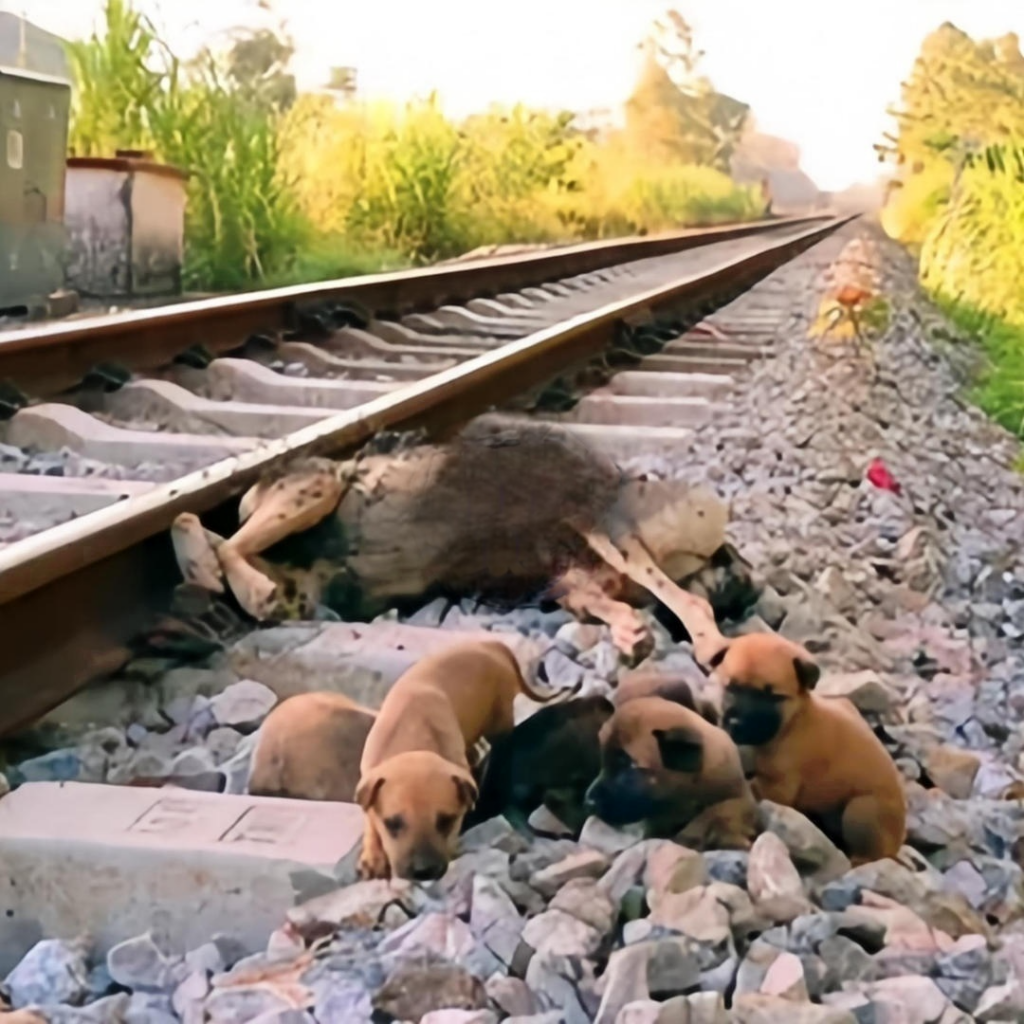
All five of them — each no bigger than a man's hand — had somehow climbed over the concrete lip of the drainage slab, crossed two feet of gravel, and found their mother's body on the rail bed.
They were pressed against her. All five of them. Lined up along her side like they were still nursing. Their eyes were barely open. Their legs were too weak to hold them steady on the rocks. They kept slipping, falling, scrambling back up and pushing themselves against her fur.
And they were crying.
Not barking. Not whimpering. Crying. A high, broken, repetitive sound that didn't stop. It came in waves — one puppy would start, then another, then all five at once, their tiny mouths open, their bodies shaking with the effort of making a sound loud enough for someone — anyone — to hear.
The rail crew stood there. Two grown men. Neither one moved for almost a minute.
"I've worked this job for six years," said track inspector Dale Hutchins. "I've seen deer. I've seen cattle. I've never heard anything like that sound. Those puppies were screaming for their mother. And she was right there. And she couldn't answer."
They Wouldn't Be Moved
Dale and his partner tried to collect the puppies. Standard procedure — remove the animals, call county services, clear the track.
The puppies wouldn't go.
Every time a hand reached for them, they burrowed deeper into their mother's fur. One puppy — the smallest, a brown and white female — wedged herself under her mother's neck and went completely still. Another bit at Dale's glove. Not aggressively. Desperately. Like he was trying to hold on to the only safe thing he had left.
"We couldn't pull them off," Dale said. "Physically, yeah, we could have. But I looked at my partner and he looked at me and we both just — we couldn't do it. They were saying goodbye. I don't care if that sounds crazy. That's what it was."
They called county animal control. Estimated wait: two hours.
So they sat down on the gravel, ten feet from the mother's body, and waited. And the puppies cried. For two straight hours, they cried. Their voices got weaker. Raspier. By the end, the smallest one had no sound left at all — her mouth was still opening, still trying, but nothing came out.
Lily Heard Them From the Road
Lily Tran was fourteen years old. She lived in a house a quarter mile from the tracks. She rode her bike to school every morning along Calhoun Road, which runs parallel to the rail line.
That Tuesday, she left early. 6:30 AM. She was halfway down the road when she heard something.
"It sounded like babies," Lily said. "Like actual human babies crying. I stopped my bike and listened and it was coming from the tracks. I knew I wasn't supposed to go down there. My mom told me a hundred times. But I couldn't just leave."
She dropped her bike on the shoulder, climbed down the embankment, pushed through the brush, and found them.
The rail crew was still there. The mother was still on the tracks. And the five puppies were still pressed against her body, still crying, still refusing to leave.
Lily didn't ask permission. She didn't hesitate. She walked straight to the puppies, sat down in the gravel next to the mother's body, and picked up the smallest one.
"She was so light," Lily said. "Like holding nothing. She was shaking and her mouth was moving but no sound was coming out anymore. I just held her against my chest and said 'I'm here. I'm here. You don't have to cry anymore.'"
The puppy stopped shaking.
Then Lily picked up the second one. Then the third. She put them in her hoodie, zipped it halfway, and held the fabric like a pouch against her body. The fourth and fifth puppies she held in her arms.
All five went quiet the moment she held them.
"They just needed someone to hold them," she whispered. "That's all they needed. And nobody was doing it."
The Vet Who Almost Didn't Answer
Lily carried the puppies up the embankment, put them in her bike basket wrapped in her hoodie, and rode — slowly, carefully — two miles to the nearest veterinary clinic.
Dr. Alan Prescott was unlocking the front door when a fourteen-year-old girl showed up on a bicycle with five newborn puppies in a sweatshirt.
"I almost told her we didn't open for another hour," Dr. Prescott said. "Then I saw the puppies. Then I saw her face. She'd been crying the whole ride."
He brought them inside immediately.
The assessment was grim. All five puppies were severely dehydrated. Their body temperatures were dangerously low — the gravel had been cold overnight and they'd been away from their mother's body heat for hours. Two had minor abrasions from crawling across the railroad rocks. The smallest — the one who had lost her voice — was in the worst shape. Her breathing was shallow and irregular.
"At three weeks old, without a mother, survival odds drop fast," Dr. Prescott said. "They needed round-the-clock bottle feeding every two hours. Warming pads. Monitoring. It's intensive neonatal care. Most clinics would refer out. Most people would understand if the outcome wasn't good."
He looked at Lily. "Can you help me feed them?"
She didn't go to school that day.
Five Names for Five Fighters
Lily named them that afternoon, sitting on the clinic floor with all five puppies in a towel-lined box on her lap.
The biggest male: Diesel — because he was loud and wouldn't stop moving.
The second male: Gravel — because that's where she found him.
The brown and white female: Honey — because of her color.
The spotted female: Whistle — because she made a whistling sound when she breathed.
And the smallest one — the one who cried until her voice gave out, the one who wedged herself under her mother's neck, the one who went silent: Echo.
"Because her voice is still out there," Lily said. "On those tracks. Even after it stopped, I could still hear it."
Seventy-Two Hours
Dr. Prescott told Lily the truth: the first 72 hours would determine everything. If the puppies could stabilize — hold their temperature, take formula, gain even a few grams — they had a chance.
Lily came to the clinic before school. After school. During lunch. Her mother, Karen Tran, drove her at 11 PM for the late feeding and again at 5 AM before the morning one. For three straight days.
On hour 36, Whistle crashed. Her temperature dropped. Her breathing went irregular. Dr. Prescott worked on her for twenty minutes while Lily stood in the doorway holding Echo and watching.
Whistle pulled through.
On hour 54, Diesel started eating on his own — latching onto the bottle nipple and pulling so hard he nearly yanked it out of Lily's hand. She laughed for the first time in three days.
On hour 72, all five puppies were stable. Gaining weight. Warm. Breathing evenly. Alive.
Dr. Prescott came into the room, looked at Lily asleep on the floor with the box of puppies on her chest, and turned to her mother.
"That girl saved five lives this week," he said. "I want you to know that. Without her, they wouldn't have made it."
Where They Are Now
Lily's family fostered all five puppies through their first eight weeks. Lily bottle-fed them every two hours for the first ten days. She slept on the laundry room floor next to their box every night because she was afraid one of them would stop breathing and she wouldn't hear it.
At eight weeks, Diesel and Gravel were adopted together by a retired couple in Columbus, Georgia who had lost their dog the year before. Honey went to a family with three kids who had been on a shelter waiting list for months. Whistle — the one who almost didn't make it at hour 36 — was adopted by one of the vet techs at Dr. Prescott's clinic.
Echo stayed with Lily.
"She was never going anywhere else," Lily said. "From the second I picked her up on those tracks, she was mine. She just didn't know it yet."
Echo sleeps at the foot of Lily's bed every night. She's nine pounds now. Healthy. Loud — her voice came back on day four and hasn't stopped since. She barks at the mailman, at squirrels, at her own reflection in the sliding glass door.
"She's making up for lost time," Lily says. "She went silent once. She's never going silent again."
Five puppies. One mother who gave everything. One girl who climbed down when everyone else walked past. And a voice that came back from the silence — because somebody finally listened.
Share this story. Not for us. For the strays still out there on the tracks, in the ditches, behind the buildings — the ones crying right now with no one close enough to hear. Be the person who climbs down.