You're going to want to stop reading this halfway through. Don't. He didn't stop waiting. You don't get to stop reading.
The Chain
A utility worker named Dean Harlow was checking a drainage line off County Road 12 outside Del Rio, Texas on a Thursday morning when he saw the chain first.
Not the dog. The chain.
Silver links stretched across the dry ground, running from a cracked concrete post near the edge of a drainage ditch to something lying in the dirt about six feet away. At first Dean thought it was a bag of trash. That stretch of road collected everything nobody wanted — plastic bags caught in dead branches, broken bottles, fast food wrappers bleached white by the sun.
Then the bag moved.
"I stopped walking," Dean said later. "I was maybe thirty feet away. And I watched this white shape lift its head about two inches off the ground, look at me, and put its head back down. That's when I realized it was a dog. And that's when I saw the ribs."
What Dean Found
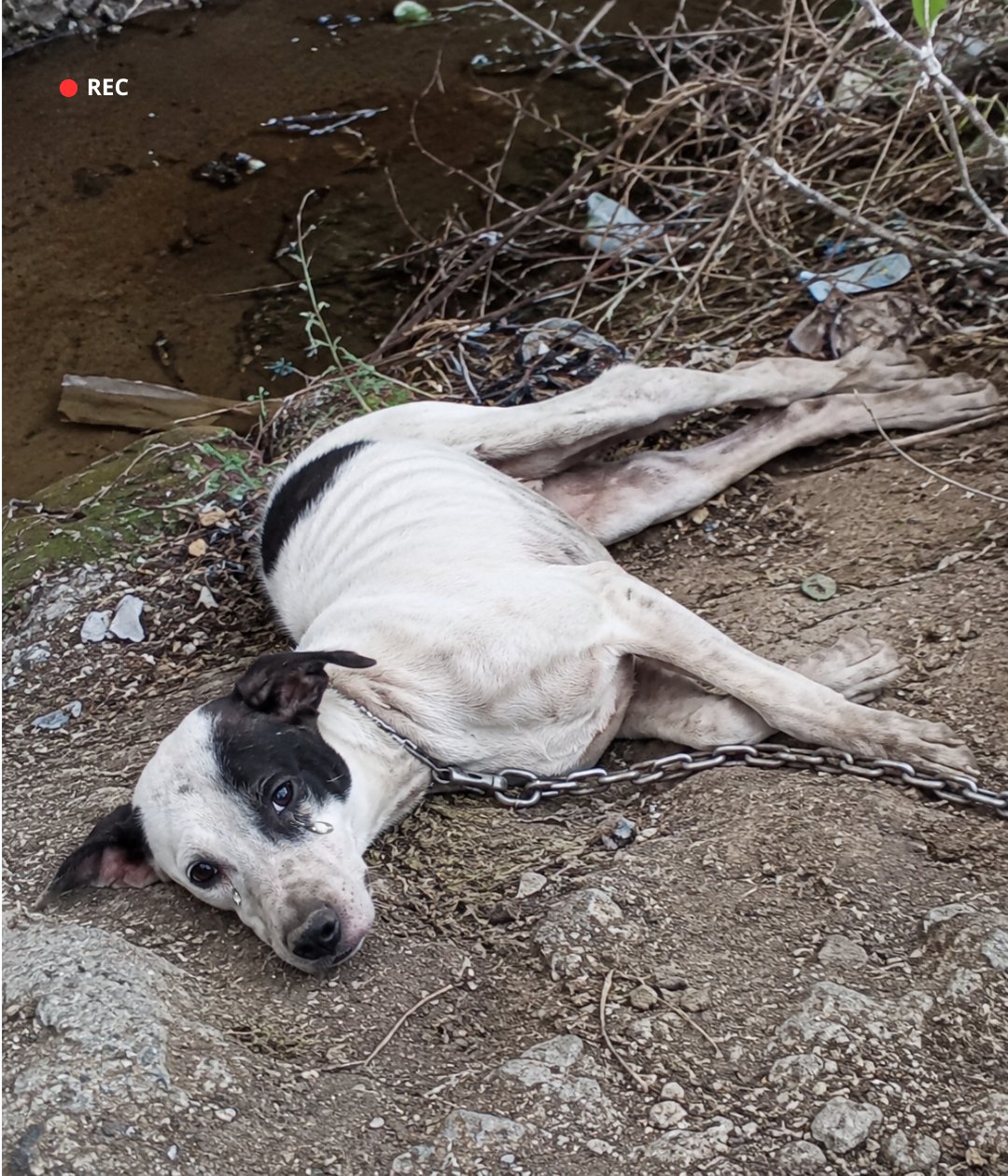
He was white with a single black patch around his left eye. Medium build — or what had once been medium build. Now he was skeletal. Every rib showed through his skin like fingers pressing outward from the inside. His hip bones jutted upward. His legs were stretched out in front of him, long and thin, bent at angles that suggested he had tried to stand many times before the ground finally convinced him to stop.
A heavy chain — the kind used for towing equipment, not for animals — was wrapped once around his neck and clipped to the concrete post with a rusted carabiner. The chain was short. Maybe four feet of slack. Enough to lie down. Enough to reach the edge of the ditch. Not enough to reach the road.
Never enough to reach the road.
The ditch beside him held a few inches of brown water — stagnant, covered with a film of dust and dead insects. That was his water source. The only liquid within the length of that chain.
There was no food bowl. No shelter. No shade. Just dirt, dead branches, roadside trash, and a dog who weighed less than half of what he should have.
But his eye was open.
That was the part Dean couldn't get past. His body had quit. His legs were done. His muscles had been consumed by his own body trying to stay alive. But that one eye — the one ringed by the black patch, the one that looked almost human in its sadness — was open. Not wide with panic. Not squeezed shut in pain. Just open. Watching. Still watching the road.
"He wasn't crying," Dean said. "He wasn't whining. He was just looking at me like he had been looking at that road for weeks, waiting for someone to walk down it and actually stop."
How Long
The vet who examined him later — Dr. Maria Saldana at Val Verde Animal Hospital — estimated he had been chained there for three to four weeks.
Three to four weeks.
In South Texas heat. With no food. With ditch water as his only hydration. With a chain heavy enough to anchor a boat wrapped around his neck.
He weighed 24 pounds. A dog his size — Dr. Saldana estimated he was a pit bull mix, roughly two years old — should weigh between 50 and 60 pounds. He had lost more than half his body weight.
"His body was in the process of shutting down," Dr. Saldana said. "His kidneys were failing. His muscles had atrophied to the point where he physically could not stand even if he wanted to. His skin was burned from the ground heat. He had open sores on his hip and shoulder from lying in the same position on concrete and gravel."
She paused before saying the next part.
"He had maybe 48 hours left. Maybe less. If that utility worker had come a day later for that drainage check, he would have found a body, not a dog."
The First Touch
Dean called Border Paws Rescue, a volunteer group that operated out of a woman's garage in Del Rio. The founder, Jackie Vega, arrived in fourteen minutes. She brought bolt cutters.
When Jackie crouched down three feet away from him, the dog didn't growl. He didn't flinch. He didn't try to move. He just shifted his eye — that one open eye — from the road to her face.
"I've cut chains off dogs before," Jackie said. "Dogs that snap at you. Dogs that scream. Dogs that try to run the second they're free. He didn't do any of that. He just looked at me. And I swear to God, his tail moved. Just once. Just the tip. Like the last muscle in his body that still worked was the one connected to hope."
Jackie cut the chain. The moment it fell away from his neck, he let out a sound. Not a bark. Not a whine. A long, low exhale — like he had been holding his breath for a month and finally let it go.
She slid her arms under him and lifted. He weighed nothing. Twenty-four pounds of bone and skin and whatever was left of a dog who had been sentenced to die by someone who couldn't even be bothered to pull the trigger — just left him there and let the sun do it instead.
He pressed his head into Jackie's chest. His eyes closed. Both of them, for the first time in what might have been weeks.
"That's when I lost it," Jackie said. "Because I realized he hadn't been sleeping. He'd been keeping that eye open the whole time. Watching. Waiting. He didn't let himself sleep because he was afraid he'd miss the person who might come. He stayed awake so he wouldn't miss his chance."
The First 72 Hours
Dr. Saldana started IV fluids within twenty minutes of arrival. His veins were so collapsed from dehydration that it took three attempts to place the line.
They couldn't feed him solid food. His stomach had shrunk so severely that anything more than liquid nutrition could have killed him. They started with electrolyte solution — two tablespoons every thirty minutes. He licked the bowl clean each time and then looked up at the tech as if asking whether that was all there was.
For the first twelve hours, his body temperature wouldn't stabilize. He was hypothermic despite the Texas heat — his body had nothing left to burn for warmth. They wrapped him in heated blankets and placed warm water bottles along his spine.
He didn't sleep that first night. Every time a door opened, his head lifted. Every time footsteps passed, that eye tracked them. Jackie sat with him until 2 AM. When she finally stood to leave, he let out one small sound — barely a whimper — and she sat back down.
She stayed until morning.
"I couldn't leave him," she said. "He'd been left enough."
Day by Day
Day two: He drank water on his own for the first time. Real water. Clean water. He stood over the bowl for thirty seconds before he started drinking, like he couldn't believe it was real.
Day four: He ate soft food. Small bites. He didn't rush. He ate the way a person eats who hasn't had a meal in so long that they've forgotten how to trust that the food won't disappear.
Day seven: He stood. His legs shook so badly that Jackie had to hold a towel under his belly to keep him upright. He stood for eleven seconds before his legs gave out. But he stood.
Day ten: He walked. Three steps. Across the kennel floor. Then he lay back down, exhausted. But he walked.
Day fourteen: He walked outside. Jackie opened the clinic's back door and he stood at the threshold for almost a full minute, staring at the grass like he'd never seen it before. Then he stepped onto it. He lowered his nose to the ground and smelled the grass for so long that Jackie started laughing through tears.
"He was smelling the world," she said. "He'd been staring at dirt for a month. And now he was standing on grass and he couldn't believe it."
Day twenty-one: He ran. Jackie threw a ball across the yard and he chased it. Badly. His legs were still weak. His coordination was still off. He tripped over his own feet, crashed into a bush, came out with leaves stuck to his face, and brought the ball back with his tail going so fast it was a blur.
Every person at the clinic stopped what they were doing and watched. Two of them were crying.
Named
Jackie named him Keeper. Because he kept his eye open. He kept watching. He kept waiting. He kept himself alive long enough to be found.
"Everything in his body was telling him to let go," Jackie said. "And he just kept going. He kept that eye open. That's not survival. That's something else. That's a soul refusing to quit."
Who Did This
Val Verde County Sheriff's Office opened an investigation. Security footage from a ranch camera half a mile up the road showed a dark pickup truck pulling off County Road 12 at 11:47 PM on a Saturday night, roughly twenty-six days before Dean found Keeper. The truck stopped for less than two minutes. A figure got out, walked to the edge of the ditch, and drove away.
Two minutes. That's how long it took someone to chain a dog to a post and leave him to die.
The driver was identified through a partial plate match. He was a 34-year-old man who lived nine miles away. When deputies arrived at his property, they found two more dogs chained in the backyard — both underweight, both dehydrated, both standing in their own waste.
All three dogs were seized. The man was charged with three counts of felony animal cruelty. His court date is pending.
Where He Is Now
A retired firefighter named Grant Sutherland from Austin adopted Keeper five weeks after the rescue. Grant had lost his own dog — a thirteen-year-old lab mix — eight months earlier and told his wife he wasn't ready for another one. Then his daughter showed him Jackie's post. A photo of Keeper on day one — skeletal, chained, one eye open — next to a photo of Keeper on day twenty-one — standing on grass with a ball in his mouth and leaves stuck to his face.
Grant drove to Del Rio the next morning without telling his wife. He called her from the clinic parking lot. "I'm bringing him home," he said. She said, "I know."
Keeper weighs 52 pounds now. His ribs are gone. His coat grew back white and thick with that same black patch around his eye. The sores on his hip and shoulder healed into small scars hidden under new fur. His kidneys recovered fully.
He sleeps on a bed in Grant's living room. A real bed. With a blanket. He sleeps fully now — both eyes closed, body relaxed, legs twitching in whatever dream dogs have when they finally feel safe.
But every morning, when Grant opens the front door to get the paper, Keeper walks to the doorway and stares down the road for about ten seconds. Then he turns around, walks back inside, and goes back to his bed.
Grant thinks he's checking. Making sure the road doesn't lead back to where he was.
"He was chained to a post in the dirt for a month," Grant said. "He couldn't stand. He couldn't eat. He couldn't reach the road. And he still didn't close his eye. He waited. He waited until someone came. And someone came."
Someone always needs to come. Make sure it's you.
If this story moved you, share it. Somewhere tonight, a dog is chained to something he can't break, watching a road he can't reach, keeping one eye open because he hasn't given up yet. One share might be the reason someone drives down that road tomorrow.