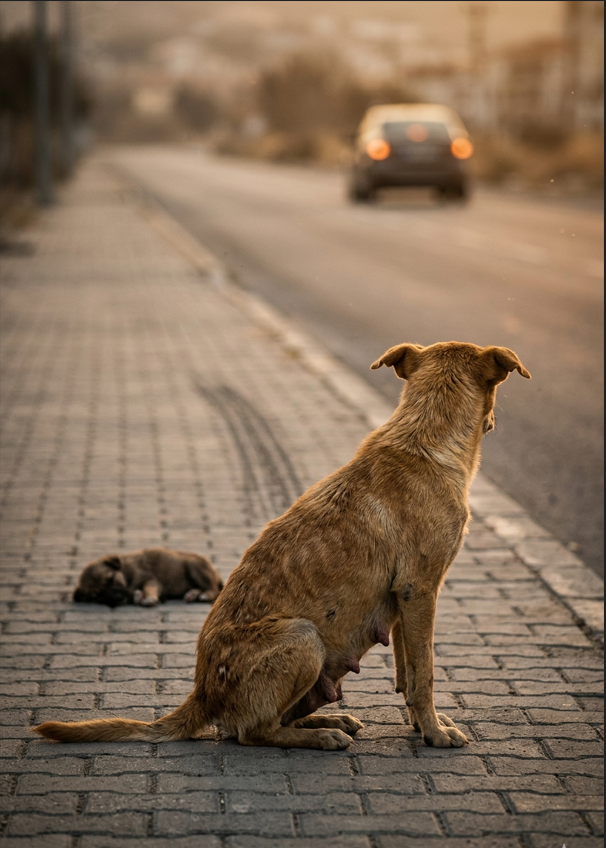
The road was long and straight, the kind that cuts through the edge of a town where no one walks unless they have to. The brick pavement shimmered in the late afternoon heat. And in the middle of it, a dog sat perfectly still, facing the direction the car had gone. She had been sitting there since morning. She had been sitting there since yesterday. She had been sitting there since the day before that.
The Spot Where He Left Her
She was golden-brown, the color of dust and sunlight mixed together. Her ribs pressed against her skin like fingers pushing through fabric. Her nipples hung low and swollen — she had been nursing recently. Her fur was matted in places where she had been lying on the same patch of ground for too long.
She sat upright. Ears slightly forward. Eyes locked on the road ahead. Watching. Waiting. Every muscle in her thin body focused on one single point in the distance — the place where the road bends and cars first appear.
Every time a car came into view, her ears would lift. Her body would tense. Her tail would move — not a wag, not yet — just a twitch. A question. A hope so small it barely qualified as one.
Then the car would pass. It wouldn't slow down. It wouldn't stop. And her ears would drop. Her tail would go still. Her body would settle back into that same position, and she would keep watching.
She did this dozens of times a day. Every single car. The same hope. The same collapse. Over and over and over.
What Was Lying Beside Her
To her left, on the pavement, a puppy lay on its side. Small. Brown and white. Its eyes were closed. Its tiny body was still.
It had stopped breathing sometime during the first night.
She knew. Dogs always know. She had licked its face for hours after it went cold. She had nudged it with her nose, pushed it with her paw, tried to roll it over the way she did when it was alive and sleeping. She had curled around it through the night, sharing warmth that was no longer needed with a body that could no longer feel it.
But she wouldn't leave it. She wouldn't move from this spot. Because this was the spot. This was where the car had stopped. This was where the door had opened. This was where a hand she trusted had set her down on the pavement and driven away without looking back.
If she moved, he wouldn't know where to find her.
So she stayed.
How It Happened
Three days earlier, she had been in a yard. It wasn't much — a patch of dirt behind a concrete wall, a bowl that was sometimes full and sometimes not, a chain that was sometimes on and sometimes off. But it was a place. It was a life she understood.
She had given birth to four puppies under the steps of the back porch. She cleaned them. She fed them. She kept them warm in the cool nights by pressing her body around them in a circle, the way her own mother had done for her, the way every mother has done since the beginning of mothers.
Two of the puppies were taken away within the first week. She looked for them. She searched the yard, the corners, under the steps. She cried at night — a low, steady whine that no one in the house acknowledged.
Then one morning, the man came out. He picked up the remaining two puppies and put them in the back seat of his car. She followed, tail wagging, because the car usually meant something good. A trip. A ride. An adventure with the person she loved.
He opened the door and she jumped in. She sat in the back with her puppies, licking their faces, happy. Going somewhere together.
The car drove for twenty minutes. Then it stopped. The man got out. He opened the back door. He picked up one puppy and put it on the road. Then the other. Then he grabbed her by the scruff and set her down next to them.
She looked up at him. Tail wagging. Confused. Waiting for the next part — the part where he calls her back, the part where this makes sense, the part where this is still love.
He got back in the car. He closed the door. And he drove away.
She ran after him. Full speed. Her paws slapping the hot pavement, her body stretching as far as it could, her lungs burning. She ran until she couldn't see the car anymore. Then she ran a little more, because maybe he was just around the next bend. Maybe he had pulled over. Maybe he was waiting.
He wasn't.
She walked back to where the puppies were. One was crying. The other was lying on its side, panting too hard in the heat. She lay down beside them on the brick road, in the exact spot where the car had stopped, and she waited.
She was still waiting.
The First Night
The smaller puppy died before midnight. The heat during the day had been brutal, and there was no water, no shade, no shelter anywhere on that stretch of road. Just flat brick pavement and dry earth on both sides.
She tried everything she knew. She licked the puppy's face. She nudged it toward her belly, toward the milk that was drying up because she hadn't eaten in two days. She wrapped her body around it and held it against her chest.
But the puppy went still. And then it went cold. And she lay there with it pressed against her all night, because that's what mothers do when there is nothing left to do. They stay.
The other puppy — the one that was still alive — crawled up against her neck and slept. She could feel its heartbeat. Tiny. Fast. Fragile. The only sound in the world that still meant anything.
Day Two
The sun came up and she hadn't moved. The surviving puppy nursed, but there was almost nothing left. Her body was running on empty — no food, no water, just the biological machinery of motherhood grinding forward on fumes and instinct.
Cars passed. A few. One every ten or fifteen minutes. Each time, she lifted her head. Each time, her ears went forward. Each time, something in her eyes caught fire for half a second — a flicker of recognition, of hope, of the insane belief that he would come back for her.
Each time, the car kept going.
One car slowed down. She stood up. Her tail moved. Her whole body leaned forward. The car slowed, and for three seconds, she believed. Three seconds where the world made sense again, where loyalty was rewarded, where love meant something.
The car sped up and drove past. The driver had just been checking their phone.
She sat back down.
What the Neighbors Saw
There were no real neighbors on that road. A few houses far back from the pavement. A mechanic's shop a quarter mile down that was closed more often than it was open. A woman who sold fruit from a cart on the corner during mornings.
The fruit seller noticed her on the second day. A dog sitting in the road, staring at nothing. A dead puppy beside her. A live one pressed against her ribs.
She put out a bowl of water. The dog looked at it. Sniffed it. Then turned her head back to the road. She wouldn't drink. She wouldn't eat. She wouldn't take her eyes off the bend where the cars appeared.
The fruit seller called her neighbor. The neighbor called a man who sometimes helped with strays. The man said he'd come by when he could. That was the end of day two.
Day Three
The surviving puppy was weak. It had stopped nursing. It lay against her side with its eyes half-closed, breathing in shallow, uneven breaths. She licked its face constantly — long, slow strokes with her dry tongue — as if she could lick the life back into it.
She was dehydrated. Her gums were pale. Her eyes had lost the brightness they'd had even the day before. She was dying on that road, and she knew it. But she would not leave this spot.
Because this was where he left her. And if she moved, he wouldn't know where she was.
That's the thing about dogs that most people don't understand. They don't stop loving you when you stop deserving it. They don't adjust their loyalty based on how they're treated. They don't do the rational thing and move on and find someone better.
They sit on the road where you left them, and they wait. They wait until their body gives out. They wait until the sun cooks them. They wait until there is nothing left of them except bones and the memory of a hand that once touched them with something that felt like kindness.
They wait because they don't know how to do anything else. Because you were their whole world, and the world drove away.
Marcus
His name was Marcus Rivera, and he was driving home from a job site forty miles out when he saw her.
He almost didn't stop. He was tired. It was late afternoon. He had a truck full of tools and a wife waiting at home with dinner. He had every reason to keep driving, the way everyone else had.
But something about the way she was sitting made him take his foot off the gas. Not lying down. Not wandering. Sitting. Upright. Facing the road. Like a soldier who hadn't been relieved of duty.
He pulled over about thirty feet past her. Got out. Walked back slowly.
She looked at his truck. Her ears went up. Her tail moved. Then she saw him — a stranger, not the one she was waiting for — and her ears dropped. Her tail went still. She turned her head back to the road.
Marcus crouched down. He saw the dead puppy. He saw the living one, barely hanging on, tucked against her side. He saw her ribs, her swollen nipples, her dry cracked nose, her eyes that kept scanning the road even while a stranger knelt three feet away.
He sat down on the pavement. He didn't reach for her. He didn't call her. He just sat there, in the heat, on the brick road, and he waited with her.
After about ten minutes, she looked at him. Not at the road. At him. And something in her expression shifted — not hope, not trust, just acknowledgment. A tired recognition that someone was there. That someone had stopped.
He held out his hand. She sniffed it. Then she leaned her head against his palm and closed her eyes.
It was the first time she had closed her eyes in three days.
The Rescue
Marcus called his wife. His wife called a rescue group. The rescue group sent a volunteer within the hour.
Getting her into the truck was easy. She didn't fight. She didn't run. She had used up every ounce of resistance she had just staying in that spot for three days. When Marcus lifted her, she was so light he almost stumbled — he had expected more weight, more substance, more of her. But there was barely anything left.
He placed her in the back seat. Then he picked up the surviving puppy — tiny, limp, eyes barely open — and set it against her. She immediately curled around it.
Then Marcus did something that broke the fruit seller's heart, who was watching from her cart. He walked back to the spot on the road and picked up the dead puppy. He wrapped it in a shop towel from his truck. He didn't leave it there. He didn't kick it aside. He picked it up like it mattered, because to her, it did.
She watched him do it. She watched him carry her dead baby gently to the truck and set it down on the seat beside her. And for the first time in three days, her tail wagged. Not much. Just twice. Slow and low. But it moved.
At the Vet
The vet's name was Dr. Linda Chen, and she had been doing this work for eighteen years. She had seen everything — dogs hit by cars, dogs set on fire, dogs starved to chains in backyards, dogs thrown from bridges. She thought she was past the point of being shaken.
She was wrong.
The mother was severely dehydrated, anemic, and malnourished. Her milk had all but dried up. She had a urinary infection from lying on hot pavement for three days without moving. Her paw pads were blistered. Her body temperature was elevated. She was shutting down.
The puppy was in worse shape. Dehydrated. Hypothermic despite the heat — a sign that its body was no longer regulating properly. It weighed less than half what it should have at its age. It needed IV fluids immediately, and even then, the odds weren't good.
Dr. Chen hooked them both up to fluids. She put them in a kennel together because every time she tried to separate them, the mother panicked — whining, scratching at the kennel door, refusing to lie down until the puppy was back against her.
The vet tech wrote in the chart: "Mother will not rest unless puppy is touching her. Do not separate."
Five Days Later
The mother pulled through. Of course she did. She had been refusing to die for three days on a road with no food, no water, and no reason to keep going except a heartbeat pressed against her ribs. A hospital bed and IV fluids were practically a vacation.
The puppy made it too. Barely. There were two nights where the vet wasn't sure — where the tiny body seemed to flicker between here and gone like a candle in wind. But each time, the mother would press her nose against the puppy, and the puppy would take another breath. And another. And another.
As if her mother's touch was the only thing tethering her to the world.
On the fifth day, the puppy opened her eyes fully for the first time since the rescue. She looked up at her mother. Her tail wagged — a tiny, wobbly movement that barely counted. The mother licked her face and then put her head down and slept. Really slept. The deep, heavy sleep of someone who had been standing guard for so long they had forgotten what rest felt like.
Marcus Came Back
He came back every day. Before work. After work. Sometimes during lunch. He sat on the floor of the clinic and let the mother lean against him while the puppy crawled between his legs.
His wife came on the third visit. She brought a blanket and a toy — a stuffed duck that squeaked when you squeezed it. The puppy grabbed it and wouldn't let go. The mother sniffed it, then looked up at Marcus's wife with an expression that the vet tech later described as "the most grateful face I've ever seen on a living thing."
They adopted both of them. Mother and puppy. Together. Non-negotiable.
Marcus named the mother Honey — because of her golden-brown fur, and because the first time she licked his hand, it was the sweetest, saddest thing he had ever felt.
The puppy they named Hope. Because that's what she was. The one thing that survived when everything else was taken away.
The First Night Home
Honey walked through the house slowly. She sniffed every corner, every piece of furniture, every doorframe. She checked every room. She wasn't exploring. She was making sure it was real. Making sure the doors stayed closed. Making sure no one was going to open one and drive her somewhere and leave her again.
When she finally lay down — on a dog bed that Marcus had bought that afternoon, with Hope curled against her side and the stuffed duck wedged between them — she let out a breath that seemed to come from somewhere deeper than her lungs. A breath she had been holding for three days on a hot road. A breath she had been holding since the car door closed and the engine started and the only person she ever loved became a shrinking dot on a straight brick road.
Marcus sat on the floor beside her. He put his hand on her back. She didn't flinch. She didn't tense. She pressed into his palm and closed her eyes.
She didn't look at the door. Not once.
She was done waiting.
What She Deserved to Know
If dogs could understand words, someone should have told her this:
It wasn't your fault. You didn't do anything wrong. You weren't too loud or too much or too needy. You loved the only way you knew how — completely, without conditions, without limits — and the person you gave that love to didn't deserve a single second of it.
You sat on that road for three days because you believed he was coming back. You watched every car because any one of them could have been him. You refused to eat, refused to drink, refused to save yourself — because saving yourself meant admitting he wasn't coming, and you weren't ready to let go of the only truth you'd ever known.
That he was yours. That you were his. That love doesn't just leave.
But it does. Sometimes it leaves in a car on a Tuesday afternoon and it doesn't even slow down at the bend.
And still, you waited. Because that's what love does when it doesn't know it's been thrown away.
It sits on the road. It watches every car. And it hopes.