Warning: this story contains descriptions of severe animal neglect. Read it anyway. These 133 dogs need you to know what happened to them.
It Started With a Family Trying to Help
In Rutherford County, Tennessee, a family reached out to their elderly relatives because they were worried. The house had gone quiet. Visitors had stopped being welcomed. Phone calls went unanswered for days at a time.
When they finally got inside, what they found sent them straight to the phone.
The house was dark. Every window was covered. The smell hit them before they reached the front room — ammonia so thick it burned their eyes from the doorway. And somewhere deep inside, behind closed doors, in rooms that hadn't seen daylight in what neighbors estimated was years, they could hear them.
Dogs. Dozens of them. Maybe more. Small, high-pitched sounds — not barking, not whining, but something in between. The sound of animals who had forgotten what it meant to be heard.
What Rescuers Walked Into
Animal Rescue Corps (ARC) deployed a national emergency response team within 48 hours. Their executive director, Tim Woodward, led the operation personally.
When the team opened the first door, they stopped.
The room was pitch black. The floor was covered in feces so old and so compressed that it had literally cemented the furniture to the ground. A couch in the corner couldn't be moved. A table leg was fused to the floor by years of dried waste. The walls were stained from floor to ceiling. The air quality was so toxic that responders wore full respirator masks and still reported burning in their throats.
And everywhere — on the couch, under the table, behind the furniture, crammed into corners — were Chihuahuas. Small, trembling, matted, wide-eyed Chihuahuas who had never seen sunlight. Who had never walked on grass. Who had never been touched by a hand that wasn't attached to the chaos around them.
133 of them.
Plus 12 cats. And one large mixed-breed dog who had somehow survived in a separate room, alone, in conditions just as severe.
"From the moment we arrived, it was clear these animals were in crisis," Woodward said. "These situations are heartbreaking for both the animals and the people involved. Today, we have helped not only a large number of animals but a family in crisis as well."
The Breaking Point
The crisis had spiraled months before ARC arrived.
Local animal control had been called to the property after complaints from neighbors. When officers documented the conditions inside the house, they issued an ultimatum: move the dogs into outdoor enclosures or face severe fines and possible criminal charges.
The family — overwhelmed, ashamed, and in over their heads — panicked. They built makeshift outdoor pens from wire fencing and plywood and moved the dogs outside.
It was the worst thing they could have done.
These dogs had spent their entire lives in dark, enclosed rooms. They had never felt wind. Never felt sun. Never been in an open space with more than a few square feet to move. Suddenly they were crammed together — 133 unsocialized, terrified animals — in the heat, in the light, in a space that felt nothing like the only world they had ever known.
The pack fighting started within hours.
What the Fighters Left Behind
By the time ARC responders arrived for their initial assessment, the outdoor enclosures had turned into a battlefield.
Dogs were covered in fresh, open wounds — torn ears, ripped skin, puncture marks across their faces and necks. Several had gashes so deep that muscle tissue was visible. The smallest dogs — some weighing under four pounds — had been attacked by larger members of the pack who were just as scared and just as desperate.
Heartbreakingly, the remains of at least one deceased dog were discovered on the property. The team couldn't determine whether the death was from fighting, heat exposure, or the cumulative toll of years of neglect. It didn't matter. The death confirmed what every responder already knew: this was a mass casualty event waiting to happen.
"We pulled the most severely injured animals first," said Dr. Karen Rafferty, the lead veterinarian on the response team. "Some of them were in shock. Some were bleeding so badly we had to apply pressure in the field before we could even transport them. We ran emergency triage out of the back of our vehicles because we couldn't wait."
The Diagnosis: Years of Invisible Damage
Once the dogs were safely inside the ARC Rescue Center, the full scope of the damage became clear. Veterinary intake teams worked around the clock for three days to examine all 146 animals. The medical records read like a horror list.
Severe pack fight injuries: Open flesh wounds, deep gashes, and puncture wounds from the outdoor panic. At least 28 dogs required surgical intervention.
Extreme facial deformities: Multiple senior dogs had lower jaws that were completely rotted away from untreated, advanced dental disease. Years of eating in filth, with no veterinary care, had destroyed the bone structure of their faces. Some could no longer close their mouths.
Internal parasites: Every single dog tested positive. Some had parasite loads so severe that their stomachs were visibly distended.
Respiratory distress: From years of breathing ammonia-saturated air in sealed rooms. Multiple dogs had chronic lung damage that would require lifetime management.
Eye ulcers and blindness: Dogs who had lived in total darkness for years had eyes that couldn't handle light. Several had corneal ulcers. At least four were completely blind.
Massive tumors: Growths that had gone untreated for so long they had become part of the dog's body. One seven-year-old female had a mammary tumor the size of a baseball.
Advanced congestive heart failure: In multiple senior dogs whose bodies had been running on stress, malnutrition, and adrenaline for years.
"Every single one of these animals needed immediate medical attention," Dr. Rafferty said. "Not one of them was healthy. Not one. In twenty years of emergency veterinary response, this is in my top three worst cases."
The One Who Sat in the Center
When the first responders entered the main room of the house, one dog didn't run.
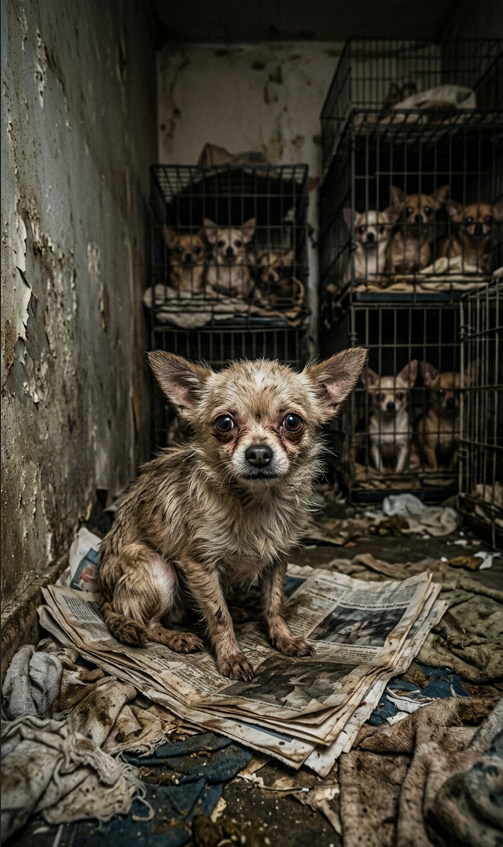
Every other Chihuahua in the room scattered — behind furniture, under debris, into corners so dark the flashlights couldn't reach them. But one small dog — a female, tan and cream, maybe three years old, maybe five, it was impossible to tell — sat in the center of the room on a pile of old newspapers and didn't move.
She was shivering. Not from cold. From fear so deep it had become her resting state. Her fur was matted flat against her body. Her eyes were enormous — round, dark, locked onto the flashlight beam like it was the first light she had ever seen.
Behind her, stacked in wire crates against the wall, were more dogs. Crammed two and three to a crate meant for one. Watching through the bars. Silent.
The responder who reached her first — a volunteer named Jesse Callahan — knelt down and extended his hand. She didn't sniff it. She didn't flinch. She just stared at it. Like she was trying to understand what it was.
"She had never been touched gently," Jesse said later. "You could tell. The way she looked at my hand — it wasn't fear of being hit. It was confusion. She didn't know what a gentle hand was supposed to do."
He picked her up. She weighed three pounds. She pressed herself flat against his chest and didn't move for the entire transport to the rescue center. She didn't shake. She didn't cry. She just went still — the way animals go still when they've decided to trust something for the first time and they're terrified of being wrong.
The Road Ahead
All 146 animals are now in ARC's care. They are getting warm meals — many for the first time in their lives. Clean water that doesn't taste like chemicals. Medical treatment for conditions that have been building for years. Soft surfaces to sleep on instead of concrete and waste.
But the hardest part isn't the physical recovery. It's the behavioral one.
These dogs don't know how to be dogs. They don't know how to walk on a leash. They don't know what grass feels like. They flinch at every sound. They freeze when a door opens. They don't understand toys, or treats, or the concept of a person sitting on the floor just to be near them.
The rehabilitation team estimates it will take three to six months before the most traumatized dogs are ready for placement. Some may never fully recover. Some will carry the scars — physical and psychological — for the rest of their lives.
But they're alive. All 133 Chihuahuas. All 12 cats. The one large dog who survived alone in a room that should have killed him. They're alive, and they're safe, and for the first time in years, someone is paying attention.
"These animals spent their entire lives in darkness," Woodward said. "Literal darkness. They didn't know the world had light in it. Now they do. And we're going to make sure they never go back."
133 dogs. One house. Years of silence. And finally — someone opened the door.
If this story shattered you the way it shattered every person on that rescue team, share it. Every share puts pressure on lawmakers to strengthen hoarding and neglect laws. Every share puts a spotlight on the organizations doing this work with almost no funding. And every share reminds people that behind closed doors, right now, in houses that look normal from the outside, animals are waiting in the dark for someone to come. Be the reason someone comes.