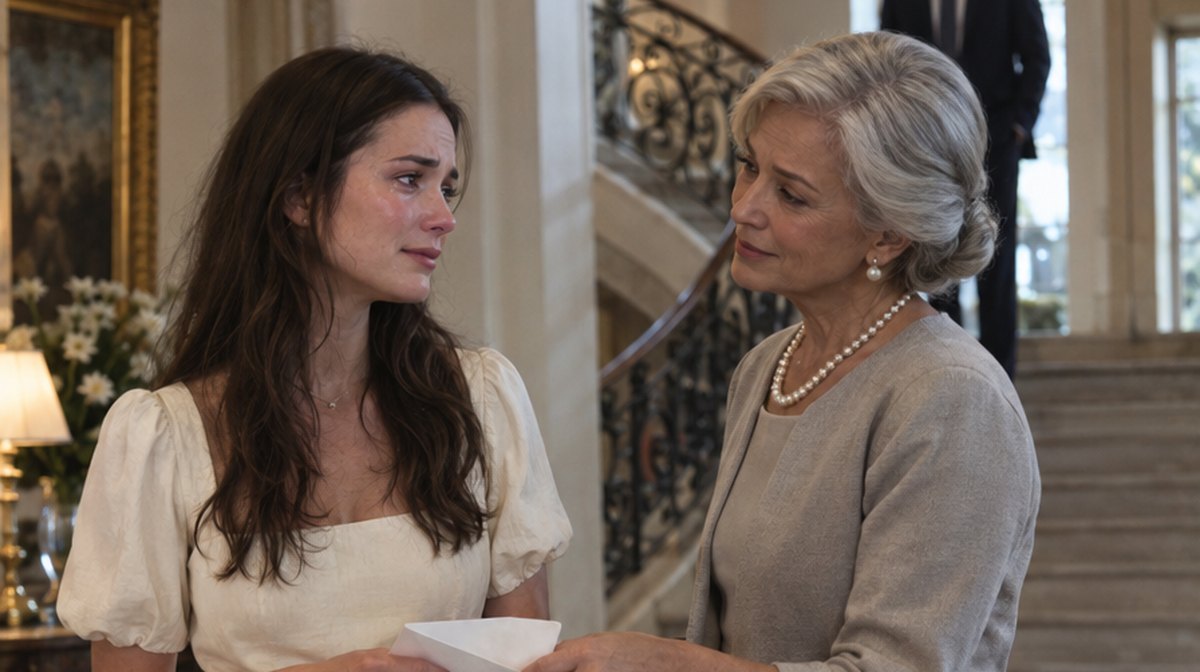
I signed a one-year contract to be a billionaire's wife so I could pay my mother's hospital bills. On the last day, with my suitcase already packed by the door, his mother pressed a sealed envelope into my hands and whispered: "He made me promise not to give you this. I'm breaking that promise."
Let me start at the beginning, because nobody believes the beginning.
Fourteen months ago I was a night-shift receptionist at a hotel downtown, and my mother was on her third week in the cardiac unit. The bills were already past ninety thousand dollars. I had sold my car. I had stopped answering unknown numbers because they were always collectors.
Then a lawyer in a grey suit came to the front desk at 2 a.m. and asked if I was Elena Ruiz.
The Contract
His client was Daniel Whitmore. Yes — that Whitmore. Real estate, shipping, half the skyline. His grandfather's trust had a clause: the company would only pass to Daniel if he was married by his thirty-fifth birthday. He was thirty-four and eleven months.
The offer was simple and insane. One year of marriage. Separate bedrooms. Appear at events, smile in photos. In return, my mother's medical bills would be paid in full and I would receive a sum at the end that made me laugh out loud in that empty lobby.
I asked the lawyer one question. "Why me?"
He said, "Mr. Whitmore asked for someone who has no interest in his money." Then he slid the contract across the desk.
I signed it the next morning, outside my mother's hospital room.
The Year
Daniel was not what the magazines said. He was quiet. He read actual books. He ate cereal standing up at the kitchen counter at midnight. The first month we barely spoke. By the third month he was waiting up for me with two bowls.
He never once crossed the line we had written into that contract. Not once. But he remembered my mother's room number. He remembered that I hated lilies. When she was discharged, there was a car waiting outside the hospital that I never ordered.
His mother, Margaret, was harder to read. Silver hair, pearls, the kind of woman who could end a conversation by setting down a teacup. For months I was sure she hated me.
And then the year ended.
The Envelope
I packed on a Sunday. Daniel was at the top of the stairs, saying nothing. I had decided I would not cry in front of him. That was my rule.
Margaret met me in the foyer. She held out a white envelope with my name on it in Daniel's handwriting.
"He wrote this the week you signed," she said. "He told me never to give it to you unless you were walking out of this house. So."
Inside were two pages.
The first was a copy of a hospital billing statement. My mother's. Dated four months before the lawyer ever walked into my hotel. Paid in full. Anonymous donor.
I didn't understand. I read it three times.
The Truth
Margaret took my hand. "Daniel stayed at your hotel last winter. The night his father died. You sat with him in that lobby for two hours at three in the morning and you never once asked who he was. You told him about your mother. The next day he paid the bill."
"Then why the contract?" I whispered.
"Because the trust clause was real, and he was too much of a coward to ask a woman he'd met once to have dinner with him. So he asked her to marry him instead." She almost smiled. "The men in this family have never been good at doing things in the right order."
The second page was another contract. It was one line long.
"Stay. No end date. — D."
The Ending
I looked up. Daniel was halfway down the stairs now, hands in his pockets, looking like a man waiting for a verdict.
"You paid it before," I said. "Before any of this. You didn't have to do any of this."
"I know," he said. "I just didn't know how else to keep you around long enough to find out if you'd want to stay."
I didn't sign the second contract. I tore it in half, set my suitcase down, and told him that if he wanted me to stay, he was going to have to ask me to dinner like a normal person.
He did. Cereal, standing up at the kitchen counter, at midnight.
We've been married — actually married — for two years now. Margaret still sets down teacups like weapons. But last Christmas she gave me a pair of pearls, and when I thanked her, she said only: "Somebody in this house had to tell the truth first."
This story is fiction, written for entertainment. Names, places and events are invented. Image: AI illustration.

