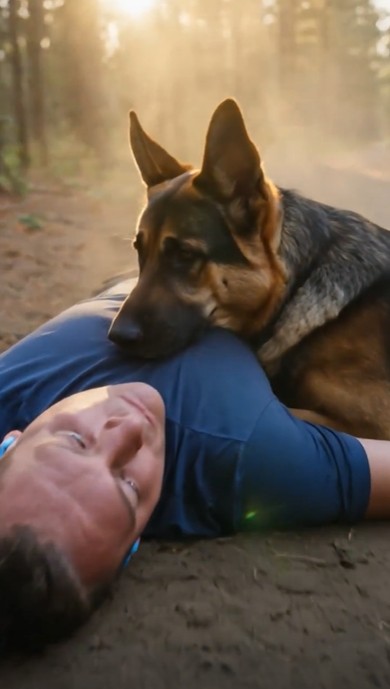
This story doesn't end the way you think it does. Read it slowly. The part that breaks people is the last paragraph.
Frank Holloway had been going to that lake for forty-six years.
It was the same wooden dock his father had built in 1971. The same cabin his grandkids called "the green house" because of the moss-stained shingles. The same fishing rod his wife Margaret had given him for their fortieth anniversary. He went there twice a week, every week, from April to October.
On the afternoon of October 4, 2025, he went there alone.
Margaret had driven into town for groceries. The kids were grown. The grandkids were at school. The only other living thing on the property was a six-year-old Golden Retriever named Murphy — Frank's shadow for the last six years, a dog who had never met a human he didn't immediately try to lean against.
The Heart Attack That Came at 4:17 PM
It was a beautiful day. 64°F. Light wind. The lake was glass.
Frank tied a fresh lure on his line, cast once, and felt his left arm go numb. He sat down on the dock to catch his breath. The numbness traveled up to his shoulder. Then his chest tightened — not pain, exactly, but a heavy iron pressure that he later described to doctors as "feeling like the lake itself had climbed up onto my ribs."
He tried to call for Murphy. His voice didn't work.
The fishing rod slipped out of his fingers and clattered onto the dock. Murphy, who had been napping on the grass beside the cabin, lifted his head at the sound — a sound he had heard hundreds of times before but never quite like this.
Frank's last thought before he lost consciousness was, *"Margaret won't be home for an hour."*
His body slumped sideways. His head and shoulders rolled off the edge of the dock.
And then he slid, slowly, into 28 feet of cold mountain water.
What Murphy Saw When He Reached the Dock
Murphy reached the dock at full sprint within nine seconds.
What he saw was the worst thing a dog can see: a bent shape disappearing into dark water, the only person in the world who fed him and walked him and slept with him, sinking out of sight beneath the surface.
The fishing rod was floating. Frank's wide-brimmed hat was floating. Frank was not floating.
Murphy did what every dog in his situation would have done first: he frantically licked the empty dock, pawed at the spot where Frank had been sitting, then ran in a tight circle barking at the lake. He looked back at the cabin. The cabin was dark. He looked at the long gravel driveway. The driveway was empty. He looked at the neighbor's cabin a mile across the cove. There were no lights on.
Murphy was alone with a problem that no Golden Retriever was ever bred to solve.
The Decision That Shouldn't Have Worked
The veterinarian who examined Murphy three days later said something most dog owners need to hear: Golden Retrievers are not natural divers. They swim on the surface. Their water-resistant coats are designed for retrieving floating birds, not for descending into dark, cold water below ten feet. Most Goldens will not voluntarily submerge their heads.
Murphy submerged his entire body.
He sprinted to the very end of the dock, skidded to a stop at the edge, stared down into the dark green water for one full second — and then he leaped.
A neighbor across the cove, a man named Tom Reynolds, happened to be on his porch and looked up at the sound of the splash. He later told paramedics that he saw "the strangest thing — a golden dog jumping off the Holloway dock, head-first, like he was diving for something specific."
Tom did not know yet that the something was Frank.
What Murphy Found 14 Feet Down
Frank was sinking face-down. His flannel shirt was billowing around his shoulders like a parachute. His eyes were closed. The cold water had triggered what doctors call the mammalian dive reflex — a survival mechanism that slows the heart and shunts oxygen to the brain — but Frank had less than ninety seconds before that reflex would no longer matter.
Murphy reached him at fourteen feet down.
What happened next was reconstructed by investigators based on the bite marks left on Frank's flannel shirt collar and the bruise pattern on his shoulders. Murphy clamped his jaws onto the back of Frank's collar — the same place he had tried to grab on the dock — and began swimming upward with everything an 84-pound dog has.
It took him eleven seconds to reach the surface.
It took him another forty seconds to swim Frank — face-up now, head held above water — the eighteen feet to the rocky shore beside the dock.
Murphy could not lift Frank out of the water. Frank was 187 pounds of unconscious dead weight. So Murphy did the only thing left to do: he held Frank's collar in his teeth, planted his paws against a rock, and refused to let him slip back in.
The Sound That Saved Frank's Life
Tom Reynolds, the neighbor across the cove, had grabbed his binoculars after seeing the dog jump. What he saw through them made him drop the binoculars and run for his boat.
"It was a dog holding a man's head out of the water," he later told the local news. "I will never forget that as long as I live."
Tom reached the Holloway dock in his small fishing boat in under three minutes. He pulled Frank — now blue-lipped and barely breathing — onto the boat. He started CPR. He called 911. Murphy sat in the bottom of the boat, soaking wet, watching Frank's face, refusing to look away.
Paramedics from the volunteer fire department arrived at the dock at 4:42 PM — twenty-five minutes after Frank's heart attack began. They got a pulse back at 4:46. They got him to the regional hospital at 5:18.
The cardiologist who treated Frank told Margaret, when she arrived sobbing at the ER, that her husband had survived a major cardiac event followed by 90 seconds of submerged drowning. Either one alone has a 30% survival rate. Both together has a 1% survival rate.
Frank was the 1%.
The Detail That Will Sit With You
This is the part nobody who reads it can stop thinking about.
When Margaret got home from the grocery store at 5:09 PM, she did not yet know any of this had happened. She walked into her empty cabin and called Frank's name. No answer. She walked out to the dock — and that's where she found something that made her drop the bag of groceries onto the wet wood.
Murphy had returned from the boat ride with Tom and the paramedics. He was sitting at the exact spot on the dock where Frank had collapsed. Soaking wet. Shivering. He had not moved from that spot since the ambulance had taken Frank away.
And next to him, neatly arranged in a row, were three things he had pulled out of the water before they left:
Frank's hat.
Frank's fishing rod.
And Frank's wedding ring — which had slipped off Frank's finger as Murphy was dragging him toward shore.
Murphy had gone back into 53°F water, alone, after the rescue was already over, and dove repeatedly until he found the one thing on Frank's body that Margaret would notice was missing.
Margaret sat down on the wet dock and cried into Murphy's wet golden fur for a very long time.
Where They Are Now
Frank had bypass surgery on October 6, 2025. He was discharged ten days later. As of May 2026, he is back at the lake twice a week, fishing from the same dock his father built in 1971.
Murphy now sleeps on the dock with him. Always. Frank doesn't go to the dock without him anymore. Margaret has made him promise.
The wedding ring is back on Frank's finger. He had a jeweler resize it, smaller, so it can never come off again.
The Last Sentence
A reporter asked Frank, after the story made local news, what he wanted to say to his dog.
Frank — a man who had built houses with his bare hands and survived two wars and raised four kids and just survived a heart attack and a near-drowning at 78 — paused for a long time before he answered.
Then he said:
"I don't think I'm allowed to say what I want to say. There aren't words big enough."
There aren't.
But Murphy knows.
If this story moved you, share it. There are old men sitting alone on docks tonight, and there are dogs lying beside them, and most people will never know that one is the only reason the other will see tomorrow.