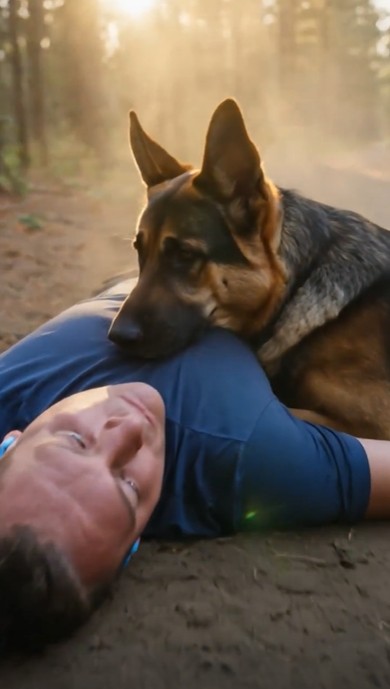
This is the kind of story that makes you look at your own dog differently. The trail is real. The dog is real. The cardiologist quoted at the end said one sentence that the man's wife has not been able to stop thinking about. Read it slowly.
Daniel Vasquez ran the same trail every Tuesday morning for the better part of nine years.
It is a three-and-a-half-mile loop through a ponderosa pine forest at the edge of a state park forty minutes north of Boise, Idaho. The trailhead is at the end of a gravel road. There is no cell service from the moment you step onto the trail until the moment you return to your car. There are no cabins, no shelters, no rangers stationed within walking distance. It is, by design, the kind of trail where you do not see another human being for the entire hour you are on it.
Daniel was forty-eight years old. He was a high-school chemistry teacher. He was a father of two girls. He was, by every measurement his doctor had ever run, in excellent health — a non-smoker, a careful eater, a lifelong runner, the kind of man whose annual physicals came back with the words "perfectly normal" written across the top.
What none of those annual physicals had ever caught was a small structural abnormality in the left anterior descending artery of his heart — a thing he had been born with, a thing that had given him absolutely no symptoms for forty-eight years, and a thing that, on the morning of May 6th, decided without warning to close.
The Dog
Atlas was four years old. A sable working-line German Shepherd, ninety-one pounds, alert ears, the kind of slightly anxious intelligence the breed is famous for.
Daniel had bought him from a breeder in eastern Oregon the year his older daughter started middle school. Atlas was not a service dog. He was not a search-and-rescue dog. He had completed eight weeks of basic obedience at a community-center class run by a retired police-dog handler and, according to that handler, was "the kind of dog you don't really train so much as get out of the way of."
He came on the Tuesday morning run every week. He stayed within ten feet of Daniel for the entire loop. He had been on the trail, by Daniel's wife Renata's careful count, three hundred and four times.
On the morning of May 6th, at approximately 7:42 AM, he became — for eleven seconds — the only thing standing between Daniel Vasquez and a death certificate.
The Collapse
The trail is laid out as a long out-and-back with a small loop at the far end. Daniel was approximately one mile and four hundred yards from his car, in the middle of a relatively flat section between two stands of older pines, when it happened.
There were no witnesses except the dog.
Renata Vasquez has reconstructed what we know about the next four minutes from three sources: the data on Daniel's smartwatch, which kept recording even after his heart stopped; the testimony of the two hikers who became involved approximately eleven minutes later; and the puncture marks on the sleeve of the long-sleeve technical shirt Daniel was wearing, which Renata has not been able to bring herself to throw away.
According to the watch, Daniel's heart rate was a steady 138 — a normal aerobic pace for him — at 7:42:11 AM.
At 7:42:12, it spiked to 184.
At 7:42:13, it dropped to 41.
At 7:42:14, the watch could no longer get a reading at all.
Daniel told Renata later that the only thing he remembers is a feeling, in the second before his legs stopped working, like somebody had reached into his chest from behind and squeezed his heart inside their fist. He remembers the trail tilting. He remembers thinking, very clearly, the words oh, this is what this feels like. He remembers thinking about his daughters.
And then he remembers nothing for the next nineteen minutes.
What the Dog Did
Atlas was three or four feet behind Daniel when Daniel went down.
According to the puncture marks on the sleeve, which were analyzed by the veterinary behaviorist Renata later consulted, the first thing Atlas did was sniff Daniel's face — briefly — then grip the fabric of Daniel's sleeve at the wrist and pull. Three or four hard pulls. The veterinary behaviorist said this is the pattern dogs use to wake a sleeping owner who has not responded to a paw or a nudge.
Daniel did not wake.
Atlas barked. Loudly, and for what the behaviorist estimates was somewhere between thirty seconds and a minute, with the kind of high, sharp, repeated bark a working-line shepherd uses for an emergency rather than the deeper warning bark they use for strangers. There was nobody on that trail to hear him.
And then — somewhere in the window between approximately 7:43:00 and 7:43:11, which is to say roughly a minute after Daniel went down — Atlas made a decision that the behaviorist would later describe as "remarkable in dogs of any breed and almost unheard of in a dog with no professional training."
He stopped barking.
He lifted his head.
And he ran.
The Sprint
Atlas did not run home. He did not run randomly. He did not run in the direction of the closer trailhead — the one he and Daniel had walked away from — even though it was less than a mile and a half away and was the route he had returned on three hundred times before.
He ran in the opposite direction.
He ran toward the far trailhead — a smaller parking area on the other side of the forest, two miles and a quarter from where Daniel was lying, that he had never once in his life visited.
The behaviorist's best theory is that Atlas heard something coming from that direction — voices, maybe, or a car door — that Daniel's failing ears could no longer pick up. The behaviorist's other theory, which she said quietly and with the careful expression of someone who is not sure whether they should be saying it out loud, is that the dog made a choice based on factors that none of us, including her, will ever fully understand.
Whatever the reason, Atlas covered the two and a quarter miles in approximately six minutes and forty seconds.
The trail is not flat. It crosses two small creeks. It climbs roughly a hundred and forty vertical feet over the last half mile.
A working-line German Shepherd at full sprint averages somewhere around twenty-eight miles per hour on open ground. The trail's terrain would have cut that average meaningfully. Renata has done the math on a napkin in the kitchen more times than she will admit and what she keeps coming back to is this: the dog did not pace himself. The dog ran every step of those two and a quarter miles as if Daniel's life depended on it.
Which, of course, it did.
The Hikers
Annika Sorensen and Wesley Park were loading day packs into the back of Annika's Subaru in the small gravel parking area at the far trailhead. They were not regulars. It was their first time at the park. They had pulled in at 7:38 to start a sunrise hike and had gotten distracted by a phone call from Annika's mother and had not yet stepped onto the trail.
At approximately 7:49 AM, a German Shepherd they had never seen before burst out of the tree line at a full sprint, ran straight across the parking area, and stopped two feet in front of Wesley with his head down and his sides heaving.
He did not bark.
He grabbed the sleeve of Wesley's jacket — the right sleeve, halfway down — and pulled.
Wesley, who is a large man and was wearing a jacket he had owned for six years, did not move. The dog pulled harder. He let go of the sleeve. He took two steps backward toward the trailhead. He turned and looked at Wesley. He took another two steps. He turned and looked again. He grabbed the sleeve a second time and pulled.
Annika later told Renata that the moment she will remember for the rest of her life is the moment she and Wesley locked eyes over the roof of the Subaru — the moment they both understood, without saying anything, that the dog had come from somewhere and that something was very wrong.
Wesley grabbed his phone. Annika grabbed the first aid kit out of the back of the car. They followed the dog into the forest at a run.
The Race Back
Atlas ran ahead of them the entire way.
He never stopped. He never slowed down enough that they could lose him. He looked back over his shoulder, Wesley said later, "about every twelve seconds, like he was counting us."
It took Annika and Wesley nineteen minutes to cover the same two and a quarter miles. They were not trail runners. They were carrying gear. They were running uphill on terrain neither of them had seen before. Annika fell once and scraped her knee badly. She did not stop.
At 8:08 AM, Atlas led them around the last bend in the trail and stopped — completely still — beside the body of his owner.
Daniel was on his back. His face was the color Annika later described to Renata as "exactly the color of paper." He had no pulse that either of them could find. He was not breathing.
Annika, who had taken a CPR refresher at her gym three months earlier, started compressions. Wesley ran back the way they had come, at a sprint, until he hit the first ridge with cell service — which, according to his call log, was four minutes and eleven seconds later — and called 911.
The paramedics arrived by helicopter twelve minutes after that.
They shocked Daniel's heart back into a rhythm on the third attempt.
The Cardiologist
The cardiologist who took over Daniel's case at the regional medical center is named Dr. Imani Ogundimu. She is, by reputation, one of the best in the state. She has been treating cardiac patients for nineteen years.
She told Renata, on the second night of Daniel's stay in the ICU, the following thing.
She said that the window between a complete cardiac arrest and the point at which brain damage becomes irreversible is, on average, somewhere between four and six minutes. After ten minutes without effective CPR, survival without significant neurological damage is unusual. After fifteen, it is rare.
Daniel had been down — without compressions, without intervention of any kind — for approximately twenty-six minutes by the time Annika started CPR.
Dr. Ogundimu said his survival, in her professional opinion, should not have been possible.
And then she said the sentence that Renata has not been able to stop thinking about.
She said: "Mrs. Vasquez, the only thing I can tell you that makes medical sense is that your husband's body was somehow kept just warm enough, just oxygenated enough, by something I cannot explain, until those hikers arrived. I would like to meet the dog."
Renata told her about the puncture marks on the sleeve. She told her about the sprint. She told her about the way Atlas had been lying with his entire body pressed against Daniel's chest when the hikers and the dog arrived.
Dr. Ogundimu listened for a long time without saying anything.
Then she said, very quietly: "He kept him warm."
What Happened After
Daniel woke up on the morning of May 9th, three days after his heart stopped, with no detectable neurological damage. The cardiologist called this "a clinical outcome I am still writing up for a journal."
He spent eleven more days in the hospital. He had a stent placed. He has been ordered to slow his running pace for at least a year. He has, with Renata's blessing, decided to keep running the Tuesday-morning trail — but with two changes.
He now carries a satellite communicator clipped to his pack.
And Atlas now runs ahead of him instead of beside him, which the dog appears to have decided on his own, and which Daniel says he is not going to argue with.
Renata, who had been on the fence about getting a second dog for almost two years before any of this happened, has stopped being on the fence. They now have a six-month-old German Shepherd puppy named Juno who follows Atlas everywhere and who, on the Tuesday-morning runs, runs at Atlas's heels exactly the way Atlas used to run at Daniel's.
Atlas is teaching her, in his quiet way, what to do.
Whatever it is that he knows.
If this story moved you, share it with somebody who has a dog. Somewhere, on a trail you have never seen, an animal is running beside a person who has no idea what their dog is capable of. They should know.

